
You looked up what a custom dining table costs and got an answer around $1,500 to $3,500. Then you asked a maker for a quote and the number was a lot higher. That's a frustrating gap, and it's a fair question to ask why.
The short answer: a custom table is one design, built once, by one person, from solid hardwood bought for your table. A big furniture brand builds thousands of the same design, often from lower-cost woods, veneers, and MDF. Those are different products with different costs, even when the photos look similar.
Below I'll walk through why online estimates come in low, where the price difference with store tables comes from, and how to read a quote once you have one. If you're mainly after the numbers, my post on how much a custom dining table costs covers what goes into a quote in more detail.
TL;DR
- Dining tables from Elmswick & Oak typically start around $3,500 and most land between $3,500 and $10,000, depending on size, wood, base, finish, and delivery.
- Online cost guides lump together DIY builds, catalog tables with a few options, and fully custom work, which pulls their averages down.
- Big furniture brands are cheaper because they build thousands of the same design, often from lower-cost woods, veneers, and MDF. A custom table is one design, built once, in solid hardwood.
- Compare quotes for the same table, not just the totals at the bottom.
Why this matters
You can find a table you love in a photograph and still end up with something that doesn't work in your dining room. Maybe the proportions feel wrong once the chairs are around it. Maybe the base looks great but sits right where your knees need to go.
That's the useful part of custom work: we can talk about those things instead of asking you to work around a table that's already been made. I'm Robert, and Elmswick & Oak is my custom woodworking shop in Ames, Iowa, serving homeowners across Central Iowa and the Midwest.
I want this to help whether you're thinking about working with me or just trying to understand what to ask another maker. You don't need to know furniture construction to have a useful conversation about a table.
What a custom dining table costs at my shop
For context, my dining tables typically start around $3,500, and most land between $3,500 and $10,000. A smaller table with a straightforward base sits toward the lower end. A long walnut top, a thicker profile, a sculptural or pedestal base, or extension leaves push it toward the upper end.
That range is a starting point, not a price list. Your table still gets its own quote, because two tables that are both "about seven feet long" can be very different projects once you get into the wood, the base, and the details.
Why online answers say $1,500
Most cost guides, and the AI answers built on them, pull from a wide mix of sources. They average together very different things under the word "custom":
- Someone building a table in their garage and counting only the lumber.
- Catalog tables where you pick a size and a stain from a set menu.
- Hobbyist makers pricing well below what the work takes.
- Independent shops designing and building one table from scratch.
Put all of those in one average and you get a number that doesn't describe any of them very well. The same guides usually mention, further down the page, that detailed hardwood tables can run $10,000 or more. That part tends to get left out of the summary.
None of this means the lower numbers are wrong for what they describe. They just aren't describing a solid walnut or white oak table designed around your room.
Why custom costs more than a big furniture brand
A national furniture brand and a one-person shop aren't running the same business, so they can't land on the same price. Here's where the difference comes from.
| Large furniture brand | Custom maker | |
|---|---|---|
| How many get made | Thousands of the same design, so setup and design costs are spread thin | One table, designed and set up once |
| Materials | Often rubberwood, acacia, or similar woods, frequently combined with veneers and MDF | Solid hardwood such as walnut or white oak, chosen board by board |
| Buying power | Materials bought in huge volume at wholesale pricing | Lumber bought for your specific table |
| Labor | Factory lines, often overseas, with each worker doing one step | One person doing the design, milling, joinery, finishing, and delivery |
| Size and design | A few set sizes and finishes | Built to your room, your chairs, and how you use the table |
To put real numbers on it: as I write this, an 84-inch extending table from a major home furnishings retailer sells for around $2,000 to $2,200. Its listed materials are solid rubberwood, MDF, and oak veneers. That's a reasonable product for what it is. It just isn't the same object as a solid hardwood table built to your dimensions.
The wood alone
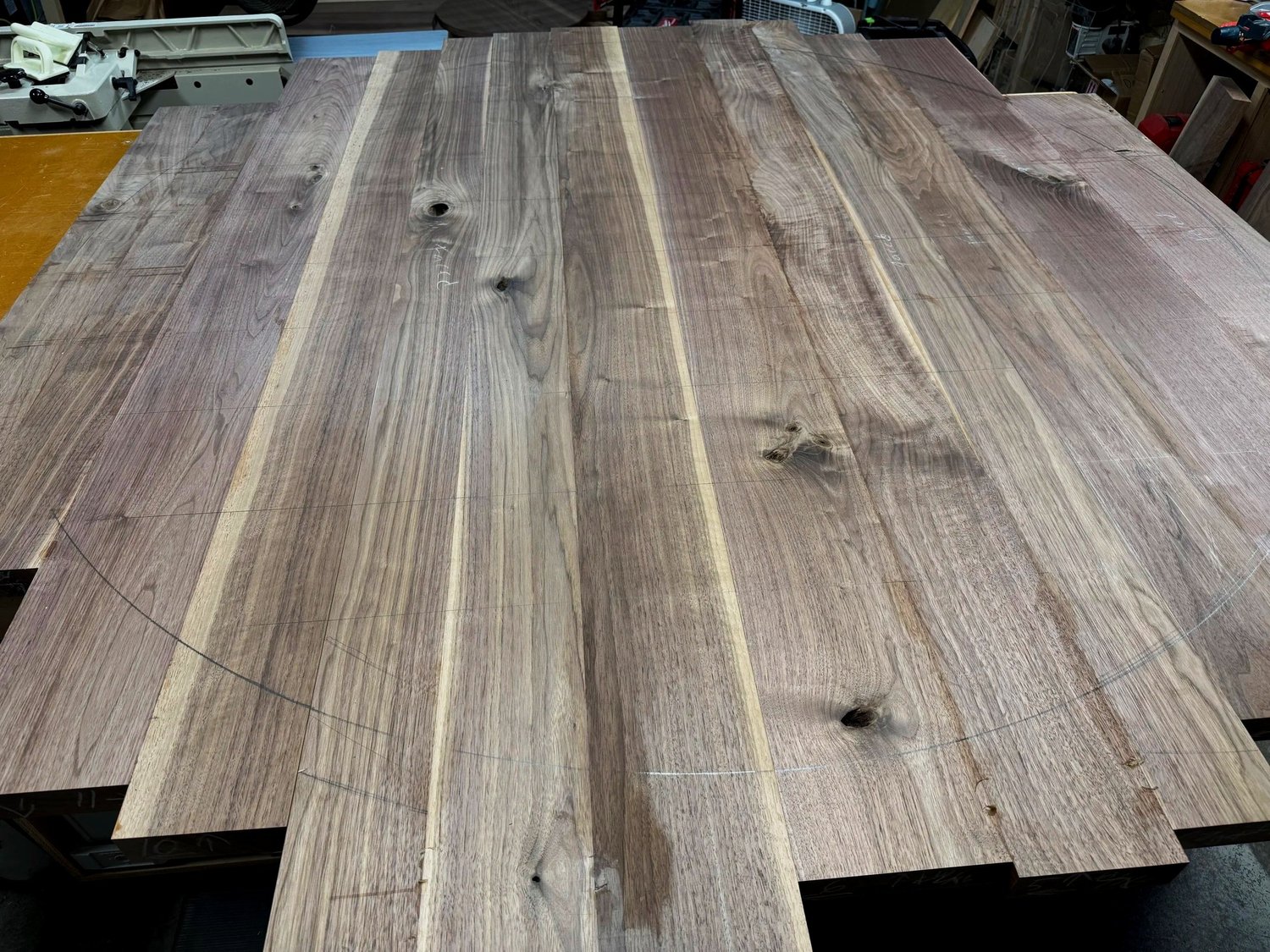
Hardwood is priced by the board foot. Lately I've been paying $13 to $15 a board foot for walnut. A substantial dining table can need well over 80 board feet of rough lumber once you account for a thick top, the base, and the waste that comes with picking boards for grain and color.
That's a meaningful part of a quote before anything gets cut. A factory using lower-cost species and veneer over engineered board starts from a much lower number.
The time
Once the design is settled, a dining table is roughly two weeks of shop time for me. That covers milling rough lumber flat and square, gluing up and flattening the top, cutting the joinery for the base, shaping edges, sanding, and finishing. None of those steps gets faster because there's only one table to make.
The parts that aren't in the shop
A custom quote also includes the conversations before the build: working out the size, the base, how your chairs fit, and the finish. It often includes delivery and placement too. A store price usually doesn't include the design work at all, because the design was done once for everyone.
Is it worth paying more?
Sometimes not, and I'd rather say that plainly. If you find an existing table you love and it works in your home, that's a perfectly good reason to buy it.
Custom makes sense when there's something you want to do differently: a specific length, a base that works with your chairs, a particular wood, or proportions you can't find in a catalog. You're paying for a table that fits a problem a store table doesn't solve.
Solid hardwood vs. veneer and MDF
Part of what you're paying for is what the table is made of, and that's worth understanding even if you end up buying from a store.
- Solid hardwood is the same wood all the way through. If the top gets scratched, stained, or worn down over the years, it can be sanded and refinished, more than once.
- Veneer is a thin layer of real wood glued over a core, often MDF or plywood. It can look good, and well-made veneer has a place in furniture. But there's only so much wood on the surface, so deep scratches and refinishing are limited.
- MDF is engineered board made from wood fibers and glue. It's stable and cheap, but it doesn't take kindly to water at an exposed edge or a chipped corner, and it can't be repaired the way solid wood can.
Read the materials line on any listing before you compare prices. "Solid wood" on a store table sometimes means the legs, with veneer over MDF on the top. A dining table top takes the most daily abuse, so that's the part to check.
What makes up a quote
When you're looking at a proposal, here's what you want to be clear on:
| Part of the quote | What to ask about |
|---|---|
| Tabletop | What are the dimensions, thickness, shape, wood, and edge details? |
| Base | How is it built, and where will the legs or supports sit? |
| Finish | What will it look like, and how do I take care of it? |
| Design | What needs to be decided and approved before the build? |
| Getting it home | Are delivery, assembly, and placement included? |
You don't need every task in the shop listed as a separate charge. You do need to understand what the finished project includes.
Compare what's included before you compare the totals. A quote that gets the table into your dining room isn't the same as one where you're collecting it from the shop. Neither arrangement is automatically wrong. You just don't want to discover the difference after you've made your decision.
Let's talk about the budget early
If you're comfortable sharing your budget, do that before getting too far into the design. It gives the conversation somewhere useful to start.
You might care most about the wood. Or the overall shape. Or having enough room for the chairs you already own. Knowing both your budget and what matters to you helps us decide which details to keep and which ones you're happy to change.
If a design doesn't fit the budget, the next question is what we can adjust. Size, materials, and construction are all things to discuss. What I won't do is pretend the same table can be made for a different amount without anything changing.
What moves a table up or down the range
These decisions aren't separate little boxes. Changing the width can affect the base. Keeping a particular chair can affect the clearance underneath. Still, it helps to know what each one does.
Size and proportions
Length, width, and thickness affect how much lumber is needed and how the top needs to be supported. But bigger isn't automatically better.
Start with the room. You need to sit at the table, pull chairs out, and walk past it. A tabletop that fills the space isn't much use if it makes the rest of the room awkward.
The wood
Walnut generally costs more than white oak. Beyond the species, grain, knots, and variation between boards are part of what you'll see in the finished table, and picking for a consistent look means buying and setting aside more lumber.
If you like a more consistent look, say so. If you like visible variation, say that too. A photograph and an explanation of what you like about it are a useful starting point.
The base
The base has a job beyond holding the top up. It also has to leave room for people.
A simple four-leg base is less work than a trestle, pedestal, or sculptural base. Legs, pedestals, and the supports between them also affect where chairs can go. A base can fit underneath the top and still be in someone's way, which is why I don't treat it as a detail to figure out at the end.
The finish
The finish changes the appearance of the wood and how you'll care for the surface. Ask what everyday use looks like: cleaning, spills, heat, and wear.
Don't assume that liking the look of a finish means you'll like everything about living with it. This is a good place to ask questions before making a decision.
Extensions and the rest of the project
Extension leaves add mechanism, hardware, and fitting time. Delivery, assembly, and access to the room also need to be clear. If there's a narrow doorway or an awkward turn on the way in, bring it up.
Where else you could look
Custom isn't the only route, and each one suits a different situation.
| Where you're looking | Best for | What to check |
|---|---|---|
| Higher-end furniture store | Finding an existing design that works for you | What is it made of, can you see samples, and what details can be changed? |
| Independent custom maker | Having a piece designed around your home | How do you work through decisions and approve the design? |
| Interior designer's furniture supplier | Coordinating a table with a wider room project | Who handles the specifications and approves changes? |
None of those routes guarantees the same services from every seller. Ask about the actual arrangement rather than assuming what comes with it.
The trade-off with custom work is that you'll be involved in decisions. That can be exactly what you want, or it can feel like more work than choosing an existing piece. Choose custom because it solves something for you: the fit, the proportions, the wood, or the way the table works with your chairs.
How long does a custom dining table take?
My furniture lead time is typically 8 to 10 weeks. A deposit reserves your spot in the build schedule, and I give you a more specific window at that point. The build itself is about two weeks once every detail is settled. The rest is design decisions, buying lumber for your table, and the projects ahead of yours.
What to have ready when you ask for a quote
You don't need to arrive with a finished drawing or every detail figured out. Here's what helps get the conversation started.
A look at the room
Take measurements and a few photographs that show the whole dining area. Include nearby furniture, doorways, and the paths people use through the space.
If you're unsure about the size, try marking the tabletop outline on the floor with removable tape. Put your chairs around it and move through the room. It makes the size easier to picture than a measurement on its own.
The chairs you're keeping
If you already have chairs, include their measurements and photographs. Arms, wide backs, and the way a chair tucks underneath all matter.
Check where your knees and feet go too. Being able to slide a chair under the edge isn't the same as being comfortable when you sit down.
How you'll actually use it
Is this where you eat every day? Does it also need to handle homework? Are you planning around your household or the occasional gathering?
Explain the everyday version first, then the guests-at-the-holidays version. Both matter, but they aren't necessarily the same seating arrangement.
Photographs with a little explanation
Reference photos help more when you tell me what you're looking at. Is it the color? The shape of the legs? The edge? Or just the way the table feels in that room?
It's equally useful to know what you don't like. You might love the top in a photograph and dislike the base.
Your budget
Even a rough number helps. Now that you know the range, you can tell me where in it you'd like to be, and we can design toward that instead of finding out at the end.
A clear written description before you approve
Before the build, make sure the dimensions, wood, design, finish, and responsibilities are written down. Ask how changes are handled and which decisions need to be settled.
Let's talk about your table
Work directly with me, Robert, on a custom piece designed for your home.
Explore custom furnitureDoes solid wood automatically make it a better table?
No. Solid wood is a material choice, not an answer to every question about construction, support, or finish.
It also moves as moisture conditions change. Ask how the design allows for that movement and what care the surface needs. There's more to a good table than the material name.
How do you compare quotes from different makers?
Give each maker the same starting information: room measurements, intended size, wood preferences, chairs, and delivery needs. Then look for differences in the designs and what's included.
If the proposals describe different tables, decide whether those differences matter to you before comparing the totals as though they're for identical work.
FAQ
How much does a custom dining table cost?
At Elmswick & Oak, custom dining tables typically start around $3,500, and most land between $3,500 and $10,000. Size, wood species, base design, finish, extension leaves, and delivery determine where a specific table lands.
Why are online estimates for custom tables so much lower?
Online cost guides average DIY builds, catalog tables with limited options, and fully custom work together. That pulls the average down. A solid hardwood table designed and built for one home usually costs more than those averages suggest.
Why are custom dining tables so expensive?
Large brands build thousands of the same design, buy materials in bulk, and often use lower-cost woods, veneers, and MDF. A custom table is designed once, built from solid hardwood, and made by one person from rough lumber to finish.
How long does a custom dining table take?
Elmswick & Oak's furniture lead time is typically 8 to 10 weeks. The build itself takes about two weeks once the design is settled.
What should I send when asking for a custom dining table quote?
Start with room measurements, chair details, reference photographs, and your budget. You don't need every decision made; explain what matters to you and what you're still figuring out.
Can I keep my existing dining chairs?
Your existing chairs can be part of the design brief. Share their dimensions and check arm clearance, leg placement, and space for knees before approving the table.
Does the quote include delivery?
Only if the quote says it does. Ask about access, assembly, and placement too, so you know who's responsible for getting the table into the room.
Who is Elmswick & Oak's custom dining table work best for?
Elmswick & Oak suits homeowners who want to work directly with me on a custom dining table designed for their home. The shop is based in Ames, Iowa, serving Central Iowa and the Midwest.
One last thing
Before you fall in love with the tabletop, look underneath it. Where are the legs? Is there a support where someone's feet need to go? Will your chairs work with it?
I know those aren't always the details that catch your eye in a photograph. But they're the details you'll notice when you sit down. A table should work just as well when you're using it as it does when you're looking at it.