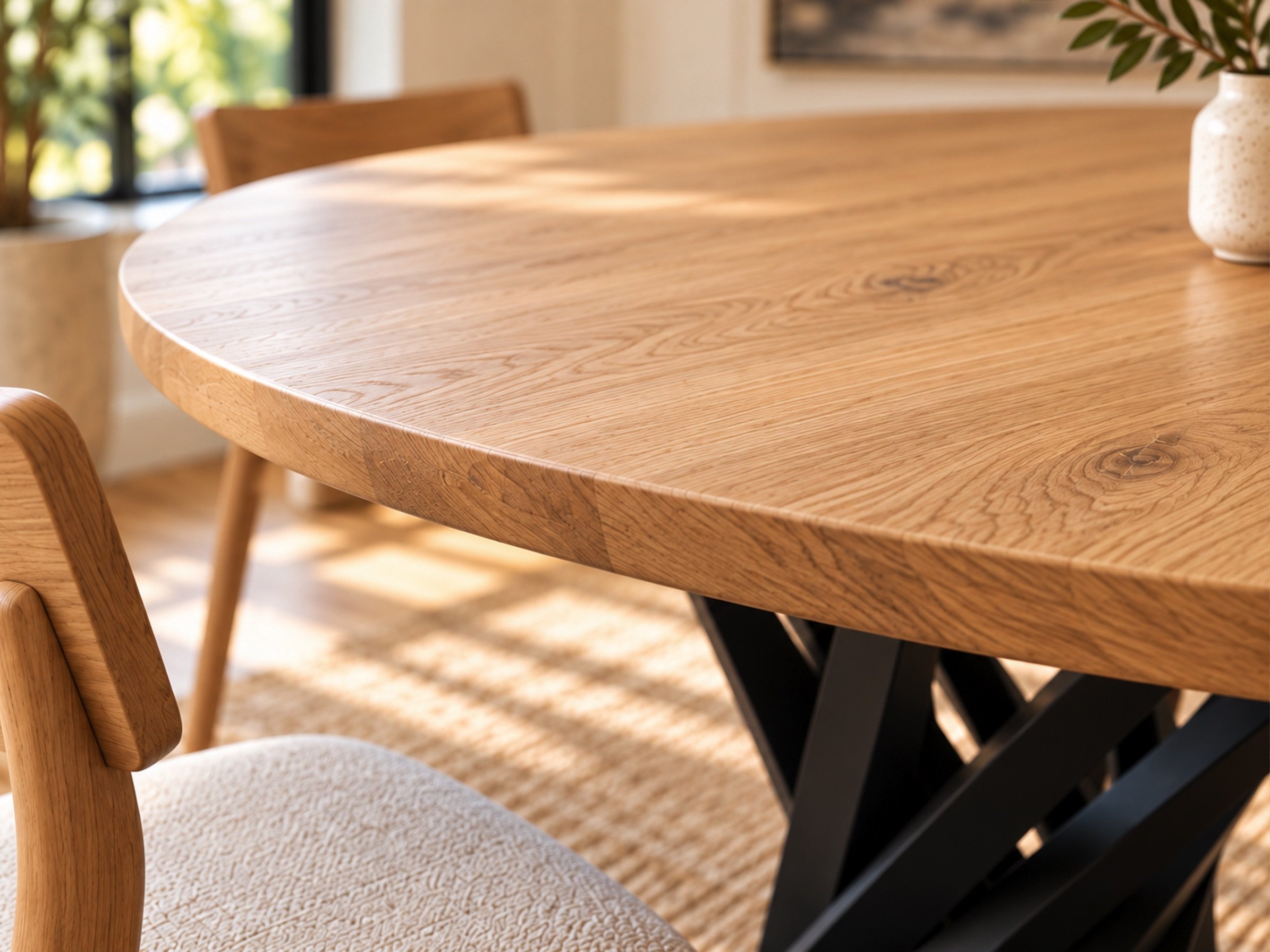
For a household table, a suitable polyurethane or professional catalyzed finish offers a protective surface coating; a hardwax oil offers a closer-to-the-wood feel with a different approach to maintenance and repair. Plain linseed oil, oil-and-varnish blends, lacquer and hardwax oil aren't interchangeable, even when the descriptions sound similar. The useful choice isn't simply oil versus polyurethane. It's how you want your table to look, feel and live with you.
The short version
- Oil vs polyurethane is only the starting question; hardwax oils and catalyzed coatings deserve separate consideration.
- Oil-based polyurethane forms a protective coating; it isn't the same as plain linseed oil.
- Water-based doesn't automatically mean weaker, and two-part doesn't identify one particular finish.
- Rubio Monocoat Oil Plus 2C balances a matte wood feel with localized maintenance, not maintenance-free ownership.
Which table finish suits your home?
Choose by your daily habits, not by which finish name sounds toughest. A table used for dinner, homework and the occasional spilled drink has different demands from a side table holding a lamp.
Here's a practical overview. These are finish families, not a ranking of every product within them.
| Finish family | Best fit | Main advantage | Trade-off |
|---|---|---|---|
| Plain linseed or tung oil | Light-use furniture and owners comfortable with upkeep | Warm color and a direct wood feel | Limited surface protection compared with suitable tabletop coatings |
| Oil-and-varnish blends | A thin, hand-rubbed appearance | Some added protection without a heavy coating | Formulas vary; the name alone says little about durability |
| Hardwax oil | A matte surface with a maintenance-and-repair approach | Close-to-wood feel; some systems support spot repairs | Spills, cleaners and worn areas still need attention |
| Oil-based polyurethane or varnish | Daily-use tables where a protective coating matters | Good spill and wear resistance in suitable products | Amber color and potentially conspicuous spot repairs |
| Water-based polyurethane or acrylic blends | Tables where a clearer color is preferred | Protective coating with less added amber in many formulas | Performance varies; local repairs can show |
| Traditional lacquer | Furniture where appearance and finish repairability matter | Smooth finish that a skilled finisher can repair | Traditional formulas have limits around liquids, solvents and heat |
| Catalyzed lacquer, conversion varnish and two-part coatings | Demanding use with a professionally applied finish | Strong resistance in products designed for that exposure | More involved application and repair; exact chemistry matters |
| Shellac or wax alone | Traditional or lighter-use pieces | Distinctive appearance and feel | Not my starting point for a hard-used dining surface |
Why this matters: protection and repair aren't the same thing
A finish can resist a spill well and still be awkward to repair after a deep scratch. Another can be easier to renew locally but ask more of you when a drink tips over.
Okay, that makes the shopping conversation a little less tidy. But it's more useful than calling one finish bulletproof and another delicate.
When we talk about a custom piece for your home, tell me what actually happens at your table. The best finish discussion starts with your household, not a chemistry lesson.
Linseed oil and tung oil: warm wood, modest protection
Linseed oil and tung oil are drying oils: they react with air and gradually harden. They bring out grain and deepen color without building the substantial protective coating you get from a film finish.
Best for: someone who values that appearance and accepts a less protected surface. Plain oil isn't where I'd start a comparison for a dining table expected to shrug off repeated spills and hard use.
Raw linseed oil, boiled linseed oil and heat-treated oils aren't identical products. Many boiled linseed oils contain added drying agents. Likewise, a can labeled "tung oil finish" can contain other ingredients rather than pure tung oil.
The homeowner takeaway is simple: ask what the finish actually is. Don't assume all products with oil in the name behave like one another, or like cooking oil.
Danish oil and other blends: the ingredients change the answer
Danish oil commonly combines oil, varnish and thinner. Other finishes mix drying oils with waxes or resins, the ingredients that help a coating harden and protect the surface.
These blends can keep a thin, hand-rubbed appearance while adding protection beyond a plain oil. But Danish oil isn't a single standardized recipe, and "oil finish" is an even broader description.
Best for: buyers who like a thin finish and understand the particular product's limits. A lightly built oil-and-varnish blend shouldn't automatically be treated as equivalent to a full protective varnish coating.
Wiping varnish adds another wrinkle. It can be thinned varnish rather than an oil-and-varnish blend, so applying a finish with a rag doesn't tell you which category it belongs to. You don't need to memorize the recipes; the maker needs to explain the finished result.
Hardwax oil: a separate option, not just another name for linseed oil
Hardwax oils are formulated finishing systems that combine oils with waxes and, in some products, additional curing components. They typically aim for a low-build surface that preserves more of the wood's texture and feel.
That doesn't make every hardwax oil identical. Some are single-component; others use a second component. Cleaning, resistance and repair instructions belong to the exact product.
Best for: someone who wants a matte, close-to-wood surface and accepts product-specific maintenance. Localized renewal can be a real advantage, but it isn't a promise that every stain, dent or scratch will disappear.
A mark in the finish and damage in the wood are different problems. If a stain has soaked into the wood, simply adding finish won't remove it.
Polyurethane and varnish: a protective coating over the wood
Varnish is a broad family, and traditional oil-based polyurethane is a type of varnish. These finishes build a continuous coating that separates everyday use from the wood beneath it.
Best for: households prioritizing resistance to ordinary spills and wear over easy localized renewal. A suitable, fully cured tabletop product can be a very practical choice.
The trade-off appears when damage cuts through that coating. Repairs can leave a visible boundary or sheen difference, and an even result sometimes requires treating the whole top. That doesn't mean every scratch demands stripping; the product and damage determine the options.
Polyurethane also doesn't have to look thick or glossy. Sheen and coating thickness are separate choices. A carefully applied low-sheen finish can look restrained while still forming a protective layer.
Oil-based versus water-based: this isn't oil versus protection
Oil-based polyurethane is still polyurethane. It isn't the same thing as wiping plain linseed oil onto wood.
In everyday terms, oil-based and water-based describe different ways the finish is formulated and carried during application. They don't tell you everything about the hardened coating.
- Oil-based coatings commonly add a warm amber tone. That can suit one wood-and-room combination and work against another.
- Water-based coatings often add less amber, making them useful when you want to keep a lighter appearance. Some are deliberately formulated to add warmth, so check a sample.
- Both categories contain different performance levels. Water-based doesn't mean the cured finish washes away, and oil-based doesn't automatically mean tougher.
Professional two-component water-based coatings also exist. Comparing one of those with a basic single-component product solely by the word water misses the important difference.
Best for: choose a water-based system when its actual performance and clearer appearance suit your table; choose an oil-based system when its performance and warmer color suit it. Neither label replaces the care instructions.
Lacquer and two-part finishes: similar names, different protection
Traditional lacquer creates a smooth surface coating and dries quickly. A skilled finisher can often blend repairs because compatible solvents soften the existing coating. Its limitations include resistance to heat, alcohol and standing liquids, depending on the formula.
Best for: furniture where that appearance and repair approach fit the expected use. Don't confuse traditional lacquer with every modern finish called lacquer.
Catalyzed lacquer uses a curing reaction to improve performance. Pre-catalyzed generally means the catalyst has already been incorporated; post-catalyzed means it is added before application. Two-part means components are mixed. It doesn't identify one universal coating.
A homeowner might hear "two-part lacquer" used loosely for several professional finishes. Ask whether the actual product is catalyzed lacquer, conversion varnish or two-component polyurethane. They aren't interchangeable names.
Conversion varnish and suitable two-component polyurethane systems can offer strong moisture and household-chemical resistance. Manufacturer testing for the exact product is more useful than assuming every professional coating performs alike.
Best for: demanding use when resistance is the priority and you accept a more involved professional repair process. These aren't casual touch-up products: mixing, application and safety requirements matter. A strong coating still doesn't make the wood underneath dent-proof.
Shellac, wax and stain: where do those fit?
Shellac gives furniture a distinctive finish and has a place in traditional work. Its sensitivity to alcohol and heat makes it a less forgiving choice for a busy dining surface. Best for: appropriate traditional or lighter-use pieces, rather than treating it as a universal tabletop answer.
Paste wax alone offers limited protection and wears with use. Best for: selected low-demand applications, not as a substitute for a suitable dining-table finish. Hardwax oil isn't simply furniture wax rubbed onto bare wood.
Stain is mainly about color, not a complete protection plan. A stain-and-topcoat system and a product combining color with protection are different approaches. "It's stained" doesn't answer how the tabletop is protected.
Why I use Rubio Monocoat Oil Plus 2C
I use Rubio Monocoat Oil Plus 2C at Elmswick & Oak, and Elmswick & Oak is an Approved Rubio Monocoat Trade Partner. Oil Plus 2C belongs in the hardwax oil category. It's not in the same bucket as plain linseed oil, and it's not in the lacquer category just because it has two components.
The reason I choose it is the balance: a matte surface that keeps the feel of the wood, practical protection for normal use, and a system that allows localized maintenance and repairs. For custom furniture, how a surface can be cared for later matters alongside how it looks when new.
The "2C" means two components: the oil and an accelerator/hardener. Rubio's current instructions specify approximately 5 days to full cure under favorable conditions when used with that second component. Light handling after roughly 24 to 36 hours isn't the same as full resistance to liquids.
That's not a claim that Rubio outperforms every sprayed coating. It doesn't. A suitable film finish can be the better choice when the priority is a substantial barrier against demanding exposure.
Rubio also isn't waterproof, heatproof or maintenance-free. Wipe spills promptly, protect against hot dishes, and follow the cleaning instructions. Spot repair is an option, not a guarantee of an invisible result. Wood color, sanding, pigment and damage depth still matter.
My finish choice is about balancing wood feel, everyday protection and future care, not winning a contest between brand names.
What changes how well a finish holds up?
- The exact formula: plain oil, hardwax oil and catalyzed coatings solve different problems.
- Preparation and application: the right product still needs the correct process.
- Full cure: dry to the touch doesn't mean ready for standing liquids or cleaners.
- Exposure: wine, hot dishes, abrasive grit and craft supplies challenge surfaces differently.
- Care: the wrong cleaner can undermine an otherwise suitable finish.
Ask to see and touch a finished sample on the proposed wood. Color and texture are easier to judge there than in a photograph or a list of ingredients.
How do I care for a Rubio-finished table?
After full cure, remove crumbs and grit with a soft cloth, wipe spills promptly, and avoid leaving the surface wet. Rubio's guidance specifies its approved cleaning products or plain water; use a lightly damp cloth rather than soaking the table, and dry afterward.
Don't experiment with all-purpose degreasers, abrasive pads or repair tricks. Maintenance should follow the surface's condition and the manufacturer's instructions, not a universal monthly re-oiling schedule. Ask before applying an unfamiliar polish or coating.
Can a damaged table finish always be repaired in one small spot?
No. A hardwax oil system can make localized work more practical, but damage to the wood can still require sanding or a larger repair. Film coatings can sometimes be repaired locally too; the difficulty is matching color, sheen and the surrounding surface.
Does a tougher finish mean I can skip coasters and trivets?
No. Use trivets under hot serving dishes and protection beneath objects likely to scratch or leave moisture. Even a resistant coating doesn't turn a dining table into a cutting board or protect soft wood from every impact.
FAQ
What's the best finish for a family dining table?
Choose a finish designed for tabletop use whose care requirements fit your household. Suitable polyurethane and catalyzed coatings prioritize a protective film; hardwax oils offer a different balance of wood feel, maintenance and localized repair.
Is Rubio Monocoat the same as linseed oil?
No. Rubio Monocoat Oil Plus 2C is a formulated hardwax oil system with a separate accelerator/hardener, not plain linseed oil.
Is water-based polyurethane weaker than oil-based?
Not automatically. Resistance depends on the particular formula, application and full cure; professional two-component water-based finishes also exist.
What does a two-part furniture finish mean?
It means two components are mixed before use. Catalyzed lacquer, conversion varnish, two-component polyurethane and Rubio Oil Plus 2C aren't the same chemistry simply because mixing is involved.
Can a matte table finish still protect the wood?
Yes. Matte describes sheen, not a universal level of protection. Both low-build oil systems and protective film coatings can have a low-sheen appearance.
Can I put polyurethane over Rubio for extra protection?
Rubio does not recommend applying polyurethane, lacquer or similar topcoats over Oil Plus 2C. Ask about a compatible finish plan rather than combining products on an existing table.
How long does Rubio Oil Plus 2C take to cure?
Rubio specifies approximately 5 days to full cure under favorable conditions with Part B. Keep the surface dry during curing and follow the instructions for the actual application.
One last thing
Keep the finish's exact name with your table's care instructions. "Oiled," "varnished" or "lacquered" won't be enough information when someone reaches for a cleaner or tries to fix a mark years later.
If you're planning a table with Elmswick & Oak in Ames, Iowa, you can discuss your project directly with me. Tell me what you want the surface to feel like and what you don't want to worry about. You don't need to arrive knowing the finish chemistry.
Talk through your custom table
Describe your household, the table you have in mind and your finish concerns.
Discuss your projectResearch behind this guide
Manufacturer guidance checked November 18, 2026: Rubio Monocoat's Oil Plus 2C instructions, cure-time guidance and care information; M.L. Campbell's MagnaMax catalyzed lacquer and Krystal conversion varnish product information; General Finishes' oil- and water-based polyurethane information; and Sayerlack's professional water-based coating guide. WOOD magazine and The Wood Database informed the explanations of traditional oils, blends, varnish, lacquer and shellac. Manufacturer claims describe their own products, not independent head-to-head testing.