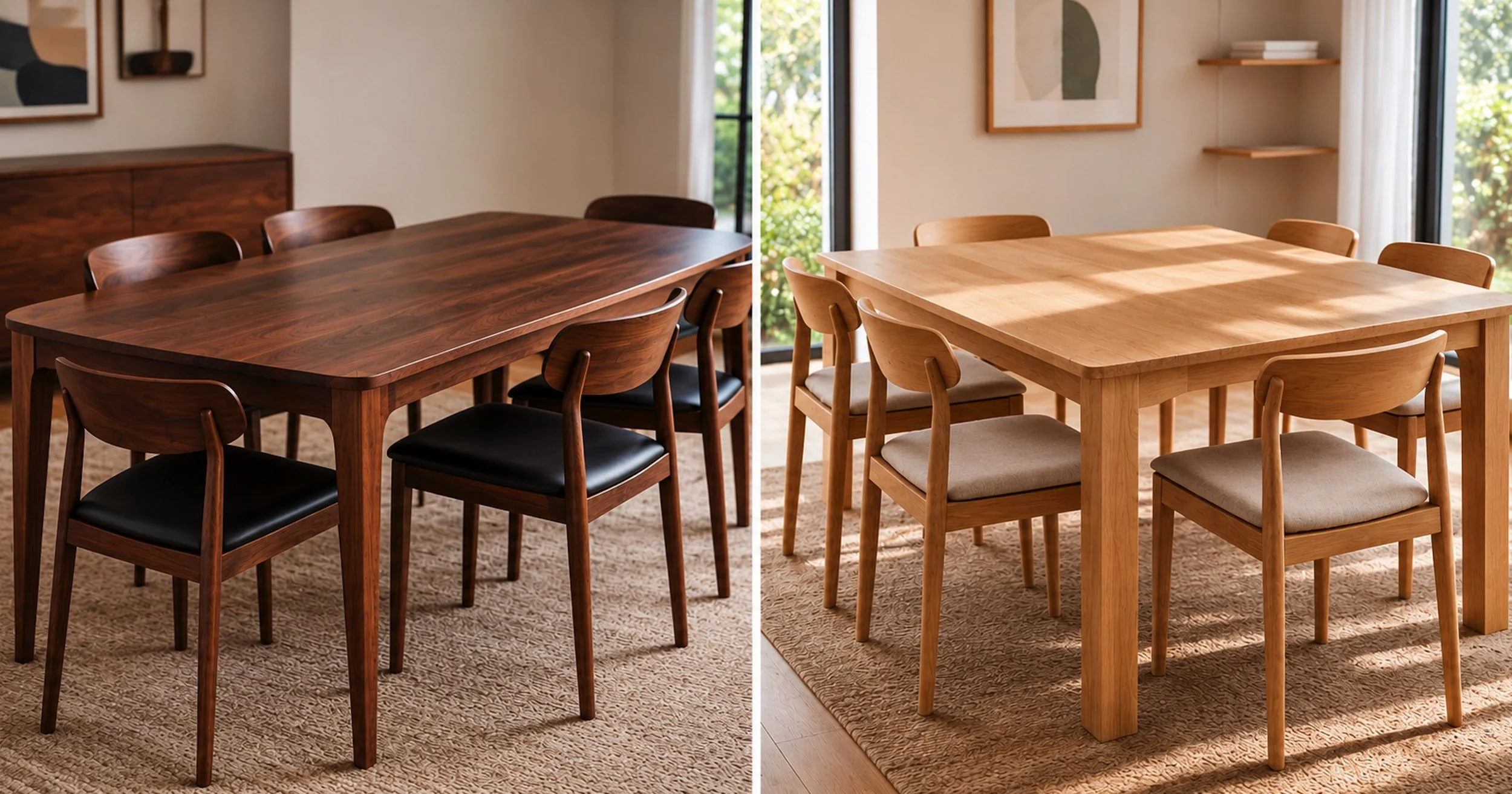
Oak is the stronger choice for an everyday dining table if resisting dents is your main concern; black walnut suits you better if you prefer its darker color and quieter grain and accept a softer surface. Neither wood is scratch-proof, and the finish, not the species alone, determines how you need to handle spills, heat, and cleaning.
- For a walnut vs oak dining table, oak wins on dent resistance; black walnut offers darker color and quieter grain.
- Red oak and white oak are different woods. Compare actual samples rather than choosing from the word oak alone.
- The finish determines cleaning and spill-care instructions; harder wood does not make a table heat-proof.
- At Elmswick & Oak, I build custom dining tables working directly with each homeowner on a piece designed for their home.
Why this matters
A dining table needs to look right when the room is tidy and work when it isn't. Plates, homework, serving dishes, and the occasional dropped fork all ask different things of the surface.
The useful question isn't simply which wood is better. It's which trade-offs you'll be comfortable living with. At Elmswick & Oak, the reason to commission a custom dining table is to work directly with me on a piece designed for your home, not to pick a species because someone called it premium.
Start by separating three decisions: the wood's appearance, its resistance to dents, and the finish's care requirements. Those overlap, but they aren't interchangeable.
Walnut vs oak dining tables: which suits everyday use?
Choose oak when dent resistance matters more than having a naturally dark tabletop. Choose black walnut when its appearance is the reason you want the table. Both can serve as everyday dining furniture when the construction, finish, and care suit the job.
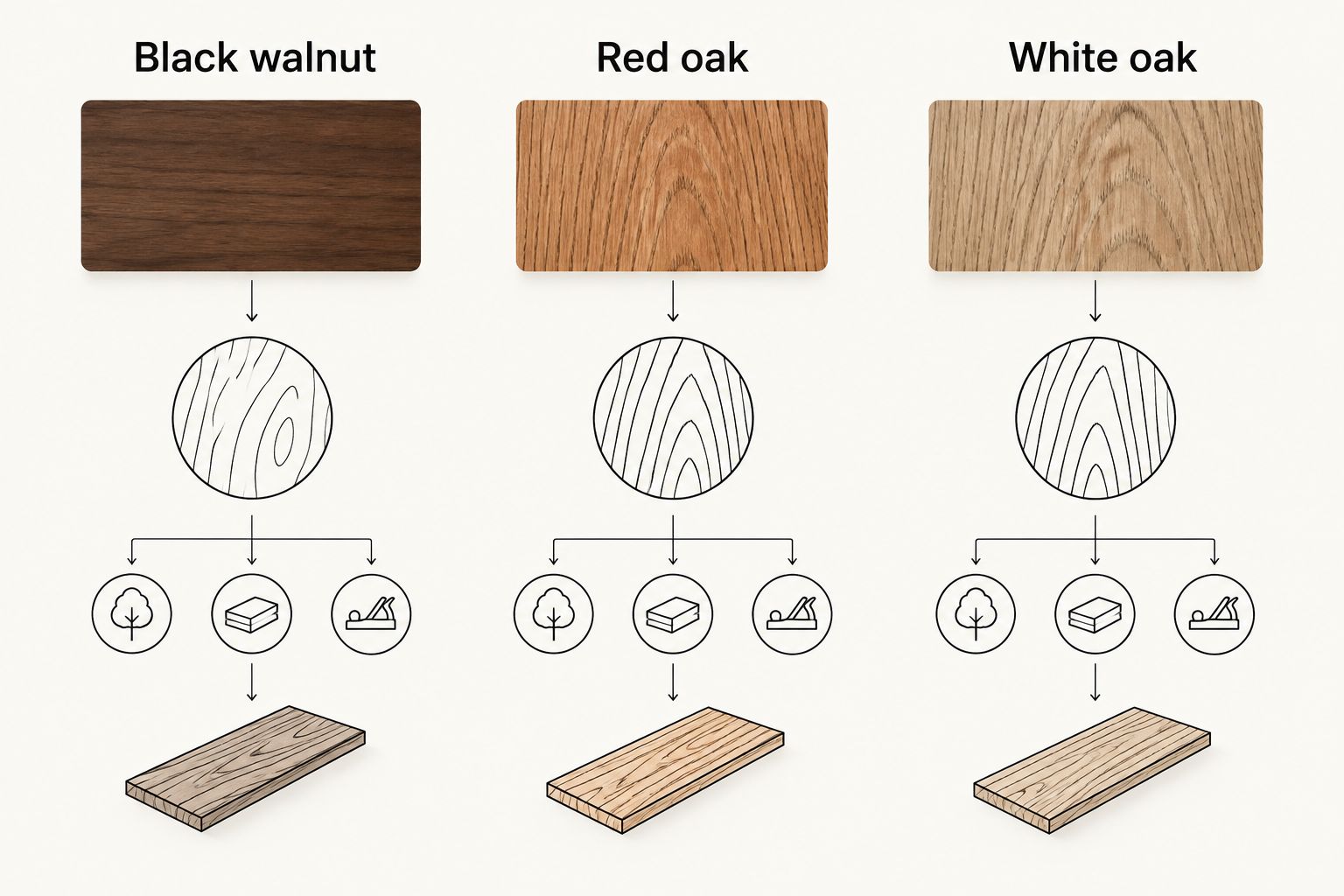
For this comparison, walnut means American black walnut. Oak needs a little more explanation because red oak and white oak differ in appearance and hardness. Ask which species a proposed table actually uses.
| Wood | Best for | Everyday advantage | Trade-off |
|---|---|---|---|
| Black walnut | Naturally darker furniture with less visually assertive grain | Brown heartwood provides color without needing a dark stain | Softer than red or white oak; pale sapwood can create strong contrast |
| Red oak | Visible grain and a warmer-looking starting point | Greater dent resistance than black walnut | Pinkish or reddish undertones need checking against floors and nearby furniture |
| White oak | Visible grain with a more muted starting color | Greater dent resistance than black walnut | Grain can be prominent; it isn't automatically a pale, uniform wood |
These are starting points, not promises about every board. Natural variation, the way boards are cut, surface preparation, and the finish all affect the result. A photograph of someone else's table won't settle what your table should look like.
Black walnut: best for naturally darker furniture
Black walnut's main attraction is its brown heartwood, which can range in tone and include darker streaks. Its sapwood is much lighter. Whether that contrast belongs in your tabletop is a design decision, not something to discover after the piece is built.
Walnut often gives a table a less visually busy appearance than strongly figured oak. That doesn't mean every walnut board is quiet, or that every oak board is dramatic. Ask about the intended grain character rather than relying on the species name.
The everyday compromise is dent resistance. Black walnut's commonly published Janka hardness is 1,010 pounds-force, below both oak species discussed here. A hard object pressed or dropped against the wood can leave a dent even when the finish remains intact.
Choose black walnut because you want walnut's appearance, not because darker wood sounds more durable. If a small dent would bother you more than giving up the dark natural color, oak deserves a closer look.
Red oak: best for pronounced grain and warmer tones
Red oak brings visible pores and grain, with a starting color that often includes pinkish or reddish undertones. Those undertones matter when you're trying to coordinate a table with an existing floor. A finish changes the appearance, but it doesn't erase the wood underneath.
Red oak's commonly published Janka hardness is 1,290 pounds-force. That makes it more resistant to indentation than black walnut under the test, though it doesn't turn a tabletop into a cutting board.
The grain can be an advantage if you want the table to have a clear wood character. It can also feel busy beside strongly patterned flooring or other prominent wood furniture. Neither reaction is wrong; the room decides more than a material ranking does.
Choose red oak when you like its grain and its finished color in your room. Don't select it solely as a substitute for a different wood, then expect stain to hide everything that makes it red oak.
White oak: best for oak grain with a more muted starting color
White oak generally starts with a more muted tan-to-brown appearance than red oak. It still varies. The pale, even tabletop in an inspiration photograph is a particular selection of boards with a particular finish. It is not the automatic result of ordering white oak.
White oak's commonly published Janka hardness is 1,360 pounds-force. It has the highest indentation resistance of these three woods, but that fact alone doesn't establish the quality of a finished table.
The board cut also matters. Quarter-sawn white oak can show conspicuous ray fleck, while other cuts produce a different grain pattern. If you want a calm surface, describe that preference explicitly rather than assuming white oak means subtle.
Choose white oak when you want its actual grain and color alongside good dent resistance. Skip the assumption that every white oak table will look neutral against every floor.
What the hardness numbers actually tell you
The Janka test measures the force needed to press a steel ball into wood to a specified depth. The figures above are standard reference values reported in wood-property references such as the USDA Forest Products Laboratory's Wood Handbook. They're a way to compare indentation resistance, not a score for the whole piece of furniture.
A fork dragged across a finish is a different problem from a heavy object denting wood. A hot dish is different again. Harder wood does not automatically mean a more scratch-resistant, stain-resistant, or heat-resistant tabletop.
Use the numbers to answer one question: how much should dent resistance influence your species choice? Then examine the finish and construction separately. You don't need to make walnut win a hardness contest to have a sound reason for choosing it.
Why everyday performance varies
Species matters, but it isn't working alone. These factors explain why two tables made from the same wood can behave differently:
- Finish system. Resistance to liquids, cleaning products, and heat depends on the actual finish. Get instructions for that product rather than generic advice for wood furniture.
- Board selection. Color variation, sapwood, knots, and grain direction change the appearance. Agree on the character you want before treating a small sample as the whole tabletop.
- Board cut. Different cuts expose different grain patterns. That affects how quiet, striped, or figured the surface looks.
- Construction. Solid wood moves as moisture conditions change. The design and attachment methods need to accommodate that movement.
- Daily habits. Writing directly on the table, sliding ceramics, and setting down hot cookware create different risks. Choose protection that suits what you actually do.
A useful conversation with a maker covers all of these. A species recommendation without the finish or construction discussion leaves too much unanswered.
Will walnut show scratches more than oak?
Walnut's lower hardness means it dents more readily than oak; it doesn't establish which finish will scratch first. Surface scratches depend on the coating, the object making contact, and how the table is used.
Visibility is another issue. A mark that contrasts with the surrounding color or sheen is easier to notice, while grain can interrupt how your eye reads a surface. That isn't the same as preventing damage.
Ask what normal wear looks like on the proposed finish and what the manufacturer recommends when a mark appears. Don't assume that rubbing in oil, sanding a spot, or using a household repair trick is compatible with the surface.
Is white oak better than red oak for a dining table?
White oak has higher standard Janka hardness than red oak, but either can be suitable for a dining table. Choose between them using finished color, grain, and the intended design, not hardness alone.
Look at a sample beside your flooring in daylight and under the room's evening lighting. Red oak's undertones might work beautifully with the room, or they might be exactly what you're trying to avoid. White oak isn't automatically the right answer because it's less reddish.
If the table needs to coordinate with existing oak furniture, identify what you're matching. Species, age, finish, and grain can all make two pieces described as oak look different.
Can you use a walnut dining table every day?
Yes, a black walnut dining table can be used every day; accepting its lower dent resistance is part of choosing it. Daily use isn't a special category that excludes softer furniture woods.
The practical question is what everyday use means in your house. If the table doubles as a writing desk, use a protective writing surface. If serving dishes arrive hot, use suitable trivets rather than asking the finish to absorb the mistake.
You don't have to treat walnut as untouchable. You do need to decide whether ordinary signs of use will feel like part of owning the piece or a constant irritation.
What to settle before commissioning the table
Bring a maker the concerns that would otherwise surface after delivery. These are more useful than asking for the best wood without explaining what best means to you.
- Name your priority. Decide whether darker natural color, quieter grain, or dent resistance matters most. A clear priority makes the compromises easier to discuss.
- Review finished samples. View the proposed wood and finish together. Bare wood doesn't tell you the final color or sheen.
- Discuss variation. Ask how pale sapwood, contrasting boards, and noticeable grain fit the design. A small sample can't show an entire tabletop's range.
- Confirm care and repair guidance. Ask what to use for cleaning, what protection is needed, and how damage should be assessed. Repairability depends on the actual finish and damage.
At Elmswick & Oak, I work directly with you on custom furniture designed for your home. My shop is in Ames, Iowa, and I build for homeowners across the Midwest. Bring the room photos and the things that bother you about your current table; those help explain the piece you're trying to replace.
FAQ
What's better for an everyday dining table, walnut or oak?
Oak is the better choice when dent resistance is your priority. Black walnut is a sound everyday choice when you prefer its darker natural appearance and accept that it is softer.
Does a walnut dining table scratch easily?
Walnut is softer than red oak and white oak, so it is more vulnerable to dents. Scratch resistance also depends on the finish; wood hardness alone doesn't tell you how easily the coating will scratch.
Is white oak waterproof enough for a dining table?
A white oak dining table should not be treated as waterproof. Follow the actual finish manufacturer's spill-care instructions and don't leave standing liquid on the surface.
Will a walnut dining table stay the same color?
Walnut's appearance changes with light exposure and aging, and its dark heartwood generally lightens over time. The finish also affects the appearance, so an exact permanent color match isn't a sensible expectation.
Can oak be stained to look exactly like walnut?
Stain can darken oak, but it doesn't change oak's grain and pores into walnut's. Compare finished samples if you're considering a darker oak table rather than expecting an exact substitute.
Should I choose a thicker top for better quality?
A thicker top does not prove that a dining table is better made. Evaluate the construction, proportions, support, and allowance for wood movement rather than using thickness as a quality score.
Does Elmswick & Oak make custom dining tables?
Yes. I make custom handcrafted dining tables at Elmswick & Oak, and you work directly with me on a piece designed for your home. My shop is in Ames, Iowa, and I build for homeowners across the Midwest.
One last thing
Look at a finished sample from a seated position, not just standing over it. That's where you'll spend time with the table, and reflected light can make the sheen and grain read differently.
If you love walnut but keep asking it to behave like oak, choose oak. If you prefer walnut enough to accept its softer surface, that's a reasonable choice too. The right material is the one whose trade-offs you understand before it becomes your dining table.