How narrow can a dining table be and still work?
A dining table can work at 30 inches wide with people seated on both long sides, but that’s a compact arrangement, not a promise of room for serving dishes. At 36 inches wide, you have more room between opposing place settings. A narrower table can suit one-sided dining, but before choosing it for facing seats, test your actual plates, glasses, and chairs together.
TL;DR
- How narrow can a dining table be? Use 30 inches as a compact starting point for facing seats.
- A 36-inch-wide dining table gives opposing place settings more separation and room for shared dishes.
- Test the tabletop and the base together; a narrow top doesn't guarantee comfortable seating.
- Elmswick & Oak suits Midwest homeowners who want a custom dining table designed directly with Robert.
How narrow can a dining table be and still work?
For everyday meals with people facing each other, start your planning at 30 inches wide. Treat that as a layout to test, not a universal minimum. Large plates, separate side dishes, and glasses placed behind the plates all compete for the same front-to-back space.
If you’re considering a custom dining table, Elmswick & Oak works directly with homeowners on a piece designed for their home. Width is one of the choices to settle around how you actually eat, rather than picking a tabletop dimension in isolation.
Here’s a useful comparison. These are planning examples, not fixed boundaries between a usable and unusable table.
| Table width | Best for | Main advantage | Main limitation |
|---|---|---|---|
| 24 inches | One-sided dining or a deliberately shallow eating surface | Keeps the tabletop shallow | Facing place settings leave little shared space |
| 30 inches | Compact dining with facing seats | Fits a narrower footprint than a 36-inch top | Serving dishes and larger place settings compete for room |
| 36 inches | Facing seats with more shared tabletop space | Adds separation between diners' settings | Takes more room across the dining area |
The important distinction is room for your meal versus room for everything you’d like to leave on the table. Those aren’t always the same requirement.
Why this matters
A narrow table solves a real problem when a wider top crowds the room. But narrowing the tabletop moves some of that compromise onto the people eating at it. You haven’t removed the need for space; you’ve changed where you’re asking everyone to manage without it.
That can be a perfectly sensible trade. If you plate meals in the kitchen and clear the table afterward, an open center strip might not matter much. If dinner usually involves shared bowls, bread, drinks, and several people reaching across, it matters considerably more.
Choose the narrowest table that supports your normal meal, not the narrowest one that holds two empty plates. The empty-plate test is easy to pass. Dinner is a little less cooperative.
A 30-inch-wide table: compact dining with facing seats
A 30-inch-wide dining table is a reasonable starting point when keeping the table narrow is a priority. Its strength is straightforward: people can face each other without committing to a broader tabletop.
The compromise is in the middle. Place settings don’t stop at the dinner plate. A glass needs somewhere safe to sit, cutlery needs space beside the plate, and your hands need somewhere to move without rearranging dinner.
Think about what normally sits between you and the person opposite:
A shared serving bowl needs space beyond both place settings.
A water pitcher needs a stable position that doesn’t crowd a glass.
Condiments occupy usable surface even when they’re small.
A centerpiece takes room whether dinner is simple or elaborate.
You don’t need all those things on the table. That’s the point: a compact table works better when you deliberately choose what stays off it.
The benefit is a smaller tabletop footprint. The drawback is less flexibility when a meal grows beyond your usual setup. If you regularly serve from the kitchen, that trade deserves serious consideration; if passing dishes is part of dinner, test it before settling on the width.
A 36-inch-wide table: more shared space
A 36-inch-wide tabletop adds 6 inches of total width compared with a 30-inch top. That extra space can separate facing place settings or provide more room for shared items, depending on how you arrange the meal.
It doesn’t create unlimited serving space. A large platter can still dominate the center, especially alongside pitchers, bowls, and decorations. But you’re making fewer decisions about what has to move elsewhere.
The disadvantage is just as real: those extra inches occupy the room throughout the day, not only during dinner. A wider top isn’t automatically the better choice if it makes getting past occupied chairs awkward.
Choose the wider layout when the added tabletop space solves an everyday problem. Don’t choose it just because a larger number sounds more comfortable. Comfort includes getting into the chair and moving around the table, too.
A 24-inch-wide table: test one-sided dining first
A 24-inch-wide surface is worth considering for one-sided dining, where nobody sits directly opposite you. Without a facing place setting, you’re solving a different problem: fitting your own meal onto a shallow surface.
For people facing each other, the same width is a much tighter proposition. Small place settings can physically fit while leaving little useful separation. Glass placement, reaching, and shared dishes then become the deciding issues.
The advantage is the shallow footprint. The limitation is that a layout suitable for a quick meal isn’t necessarily comfortable for a longer dinner.
I wouldn’t treat a narrow console or occasional eating surface as proof that the same width will work for your main dining table. Test the intended meal and seating arrangement, not just whether a plate fits on the top.
Why the workable minimum width varies
There isn’t one minimum width that accounts for every household. These are the details that change whether a narrow dining table feels sensible or frustrating:
Place settings: Plate diameter, side plates, glasses, and cutlery determine how much tabletop each diner uses. Test everything together.
Serving dishes: Meals plated in the kitchen require less shared tabletop space than meals served from bowls and platters at the table.
Seating arrangement: One-sided dining removes the conflict between opposing place settings. Facing seats need to accommodate both diners at once.
Chair position: Arms, seat shape, and the relationship between chair and table affect where your body sits relative to the tabletop.
Table base: Legs, aprons, pedestals, and stretchers affect knees, feet, and how closely you can pull in.
Other uses: A table used for paperwork, games, or projects has to support more than the dinner plates.
The useful question is, “What makes this width work for us?” That gives you something concrete to evaluate instead of searching for a dimension that guarantees comfort.
How to test a narrow dining table before commissioning it
You don’t need a finished table to discover that your usual dinner setup is too crowded. A full-size mock-up gives you something much more useful than a small drawing.
1. Set the width
Mark the proposed tabletop edges on a larger table with removable tape that’s suitable for its surface. Alternatively, use a stable, safely supported mock-up. Keep the surrounding surface out of play so you’re testing the proposed width, not quietly borrowing extra room.
Compare the compact layout with the next width you’re considering. Seeing both at full size makes the trade-off easier to judge.
2. Place your chairs
Use the chairs you intend to keep, if you have them. Sit opposite another person rather than checking the arrangement from above.
Notice where your body lands relative to the edge. If a chair can’t pull close enough, a tabletop that looked adequate can suddenly feel difficult to use.
3. Set the table
Bring out your everyday plates, glasses, cutlery, and the serving pieces you actually use. Include the water pitcher if it normally stays on the table.
Don’t substitute a smaller plate just to make the mock-up pass. You’re choosing furniture for your habits, not auditioning new habits for the furniture.
4. Eat a meal
Use the arrangement rather than only looking at it. Reach for a glass, cut food, pass a dish, and put things back down.
Check whether there’s a natural home for everything. Repeatedly moving the same object out of someone’s way tells you more than a photograph of a neatly arranged setting.
5. Check underneath
A taped outline tests tabletop space, not the proposed base. Discuss leg positions, apron depth, and any stretcher separately, using a drawing or physical mock-up where needed.
A successful tabletop test does not approve the base. Both have to work before the overall design is settled.
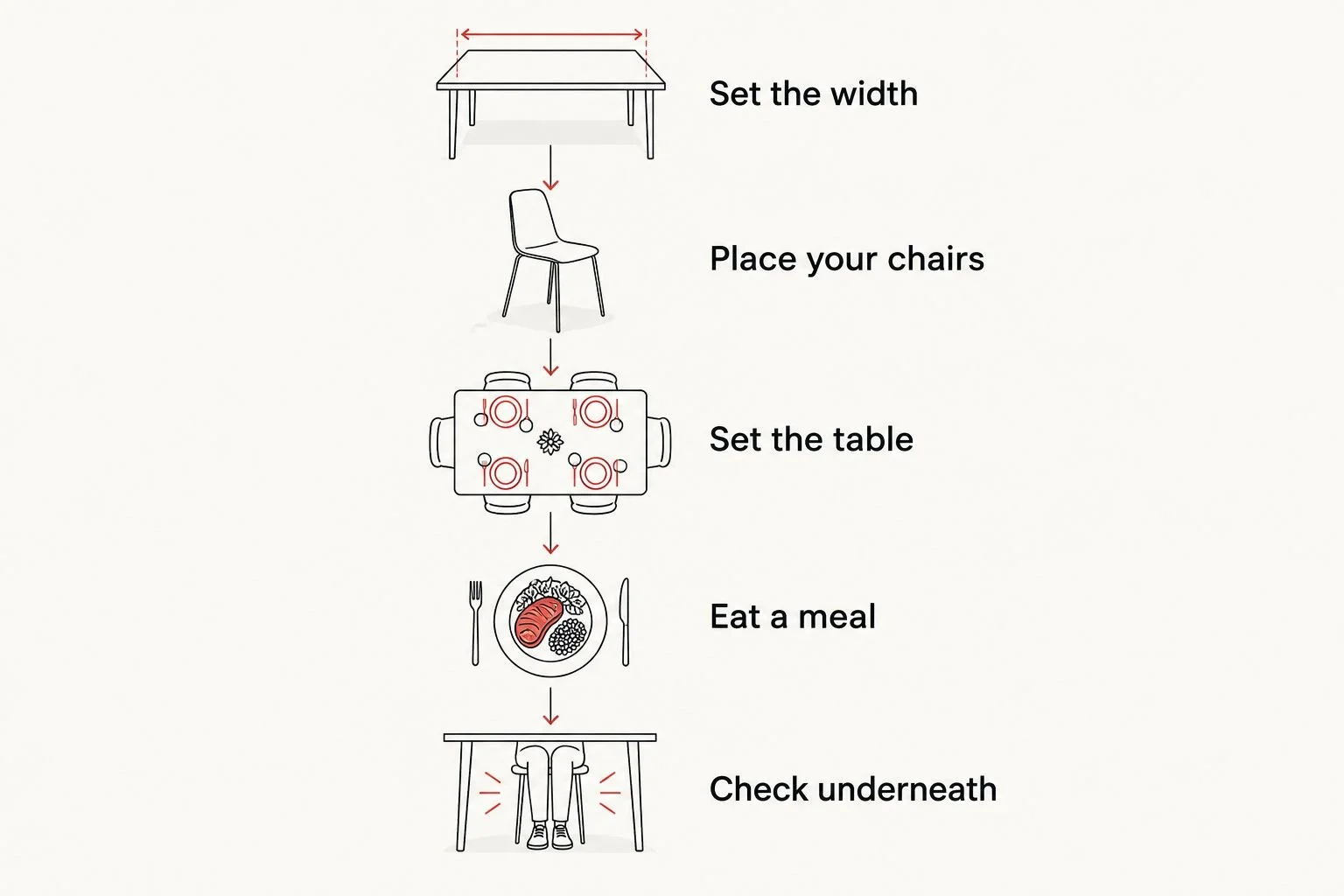
Test the meal on top and the seating space underneath as separate parts of the design.
Which design details help a narrow dining table work?
Start with usable space, not a particular style of base. A pedestal removes corner legs, but the pedestal itself still occupies space underneath. A four-leg table has a different set of obstructions; where those legs sit matters as much as their appearance.
An apron—the frame beneath the tabletop—also deserves attention. You need to understand how it relates to your thighs and any chair arms, rather than assuming the tabletop height tells the whole story.
Rounded corners can soften the route past the end of a table. They don’t increase the distance between facing place settings. Likewise, a visually light base can look less imposing without giving your plate any more space.
For a custom design, ask to see the tabletop outline and base together, with the intended seating positions shown. That makes it easier to spot a leg where someone’s knees need to go or a stretcher where their feet naturally rest.
Judge appearance, tabletop space, and legroom separately. A design can succeed at one and still need adjustment elsewhere.
Can a longer table make up for a narrow tabletop?
A longer tabletop adds room along the table, but it doesn’t increase the distance between people facing each other. If your difficulty is opposing place settings meeting in the middle, extra length doesn’t directly fix it.
Length can provide somewhere else to put a serving dish when that area isn’t occupied. The limitation is access: an open patch at the far end isn’t equivalent to shared space within easy reach.
Don’t add length simply to compensate for width without checking how you’ll use it. You can end up with more furniture in the room and the same crowded dinner arrangement.
Should you choose a narrow table or smaller chairs?
Smaller chairs can help with seating and circulation, but they don’t create tabletop depth for plates and serving dishes. Treat chair fit and tabletop width as related decisions, not interchangeable solutions.
If you like your existing chairs, include them in the design discussion early. If you’re replacing them, test the proposed chair and table relationship together. Choosing each independently leaves an important part of the fit unresolved.
FAQ
Is a 30-inch-wide dining table too narrow?
A 30-inch-wide dining table can work for facing seats, especially when meals are plated in the kitchen. Test your everyday place settings and serving pieces before choosing it.
Is a 24-inch-wide table wide enough for dining?
A 24-inch-wide table is better considered for one-sided dining than assumed suitable for facing seats. Opposing place settings leave little shared space, so a full-size test matters.
Is 36 inches a better dining table width than 30 inches?
A 36-inch-wide table provides 6 inches more total width than a 30-inch top. That helps separate place settings, but the wider tabletop also takes more room in the dining area.
Does a pedestal base make a narrow table more comfortable?
A pedestal base removes corner legs but still occupies space underneath the table. Check its position against your knees and feet rather than assuming it guarantees better seating.
Can I put a narrow dining table against a wall?
You can use a narrow dining table against a wall for one-sided seating. Test the meal layout in that arrangement, and don't assume it will work equally well when you add facing seats.
Can a custom dining table be made to suit my existing chairs?
Your existing chairs can inform a custom dining table's dimensions and base layout. At Elmswick & Oak, you work directly with Robert on furniture designed for your home, so bring chair dimensions into the discussion.
One last thing
The most useful thing to bring to a custom-table conversation might be your dinner plate. Not because the plate determines the entire design, but because it turns “we need something narrow” into a practical discussion about what needs to fit.
Bring photographs of your normal table setting, your chair dimensions, and a description of how you serve meals. A drawing with a beautiful empty center doesn’t tell the same story as a weeknight dinner.
Elmswick & Oak is best for Midwest homeowners who want to work directly with Robert on a custom dining table. From the shop in Ames, Iowa, the aim is a piece designed for your home—not a width chosen simply because it looks good on paper.