Pedestal or four legs: which dining table base works better?
A pedestal dining table works better when corner legs would interfere with your chairs; a four-leg dining table works better when you want open space through the middle and clearly defined seating positions. Neither base is automatically more stable: the base footprint, connections, tabletop proportions, and placement of your feet matter more than the name.
TL;DR
- Pedestal vs four leg dining table: choose by chair clearance, foot space, and stability, not appearance alone.
- A pedestal removes corner legs, but its column and feet still occupy space beneath the table.
- Four legs suit defined seating positions, provided chairs fit between the legs and beneath any apron.
- Elmswick & Oak is best for homeowners who want to design a custom dining table directly with Robert.
Pedestal or four legs: which dining table base works better?
Choose a pedestal for flexible chair placement around the edge. Choose four legs when their positions leave your regular seats unobstructed and you prefer less structure in the center. Both choices need a closer look underneath.
At Elmswick & Oak, custom dining tables are designed directly with Robert for your home. That makes the relationship between the base, chairs, and tabletop a design decision—not something you have to accept after choosing a top.
| Base type | Best for | Main advantage | Main trade-off | What to check |
|---|---|---|---|---|
| Single pedestal | Seating around a round top | No corner legs interrupt chair placement | The central column and spreading feet occupy foot space | Foot placement and support near the tabletop edge |
| Four legs | Consistent seating positions with clear gaps between legs | Support sits near the tabletop corners | Legs can obstruct chairs, especially near corners | Clear width between legs and clearance beneath the apron |
| Double pedestal | Longer tops where a single central support isn't the intended design | Moves support away from the corners | Pedestals and any connecting stretcher can obstruct feet | Where both supports land relative to every seat |
These are useful starting points, not guarantees. A pedestal with a broad floor base behaves differently from one with separate projecting feet, and straight corner legs create different clearances from legs that splay outward.
Why this matters: you sit beside the base, not just the top
The tabletop gets your attention first. The base decides whether you can pull your chair in, cross your legs, or move a seat slightly without meeting something solid.
That's why the same tabletop outline can feel quite different with another base underneath it. Removing corner legs can improve access around the edge while adding an obstacle nearer your shoes. Moving supports outward can clear the center while narrowing the space available to a chair.
The useful question isn't which base leaves more empty space overall. It's whether the empty space is where you need it.
Single pedestal: best for flexible seating around the edge
A single pedestal removes the corner legs that would otherwise divide the table's perimeter into fixed openings. That's especially useful around a round top, where you might rotate chairs slightly to suit the people sitting there.
But a pedestal doesn't mean an empty underside. Its central column, feet, or floor plate still need room, and those parts can land directly where you want to put your shoes.
What a pedestal improves
Without a leg at each corner, you have more freedom to position chairs around the perimeter. You aren't trying to squeeze a chair between two fixed corner supports every time the seating arrangement changes.
That freedom helps when chairs don't always return to exactly the same places. It also removes one possible obstacle when you approach the table from an angle.
What a pedestal doesn't solve
A broad base can become a footrest you didn't ask for. Projecting feet can also interfere with chair legs, even when the chair seat fits comfortably beneath the tabletop.
Stability needs its own check. A top that extends well beyond its supporting footprint needs an appropriate base and connection; a substantial-looking column alone doesn't tell you how the whole table behaves.
Pick a single pedestal because its actual shape clears your seating—not because pedestal means unlimited legroom.
Four legs: best for predictable seating positions
Four legs make the support locations easy to understand: each corner has a leg, with seating openings between them. When those openings match your chairs, the arrangement is straightforward and comfortable to use.
The catch is that tabletop length and usable seating width aren't the same measurement. Legs set inward from the ends reduce the clear opening along the sides, while thick or angled legs can take up more room than a photograph suggests.
What four legs improve
A four-leg design can leave the central floor area open, depending on whether it includes stretchers or other lower structure. That gives your feet somewhere to move without a central column immediately in front of them.
Corner supports also make the seating boundaries obvious. If you know where everyone normally sits, you can assess those exact positions rather than planning around every possible arrangement.
What four legs complicate
A chair near a corner can hit a table leg before it reaches a comfortable position. An apron—the structural rail beneath the tabletop—can also limit thigh clearance or stop a chair arm from sliding underneath.
Splayed legs deserve special attention. Their position at floor level differs from their position beneath the top, so checking only the upper connection misses a possible collision with chair legs or feet.
Pick four legs when the clear openings fit your chairs and the underside fits your knees. The overall tabletop size doesn't prove either one.
Double pedestal: best for checking a longer table seat by seat
A double-pedestal design removes corner legs but introduces two support locations along the table. It deserves its own assessment rather than being treated as a single pedestal stretched longer.
The benefit is freedom at the corners. The limitation is that a pedestal can sit directly beneath a side seat, and a connecting stretcher can occupy the space between the supports.
Check the end seats as carefully as the side seats. A pedestal set back from the end still has feet, and those feet can extend toward someone sitting at the head of the table.
For a double pedestal, map every chair against both supports. Clear corners don't guarantee clear seating along the sides.
Why comfort varies between table bases
Base labels describe the general arrangement. These details determine whether that arrangement works for you:
Support position: Legs or pedestals can sit beneath a chair even when the tabletop has ample space above them.
Floor footprint: Projecting feet, splayed legs, and floor plates affect where you can place your shoes and chair legs.
Apron depth: A rail beneath the top reduces the opening available for thighs and chair arms.
Chair shape: Seat width, arm height, and the spread of chair legs all affect fit.
Tabletop overhang: The distance between the edge and the support affects both access and the demands placed on the structure.
Connections and movement: Joinery, fasteners, base construction, and contact with the floor affect how solid the assembled table feels.
It depends is an annoying answer when you're trying to choose furniture. Here, though, you can replace that answer with a few specific checks instead of guessing from a style name.
How do you check which base fits your chairs?
Test the chair and base as a relationship, not as separate pieces. You need to know where your body and the chair land once you're actually sitting at the table.
Chair position: Mark where each regular seat belongs on a plan showing the tabletop and supports. Don't show the top alone.
Knee clearance: Check the opening beneath the tabletop, including any apron, bracket, or rail.
Foot space: Look at the base at floor level. Include projecting feet and the spread of the chair legs.
Guest seating: Add occasional seats to the plan and check their positions individually rather than assuming they'll fit.
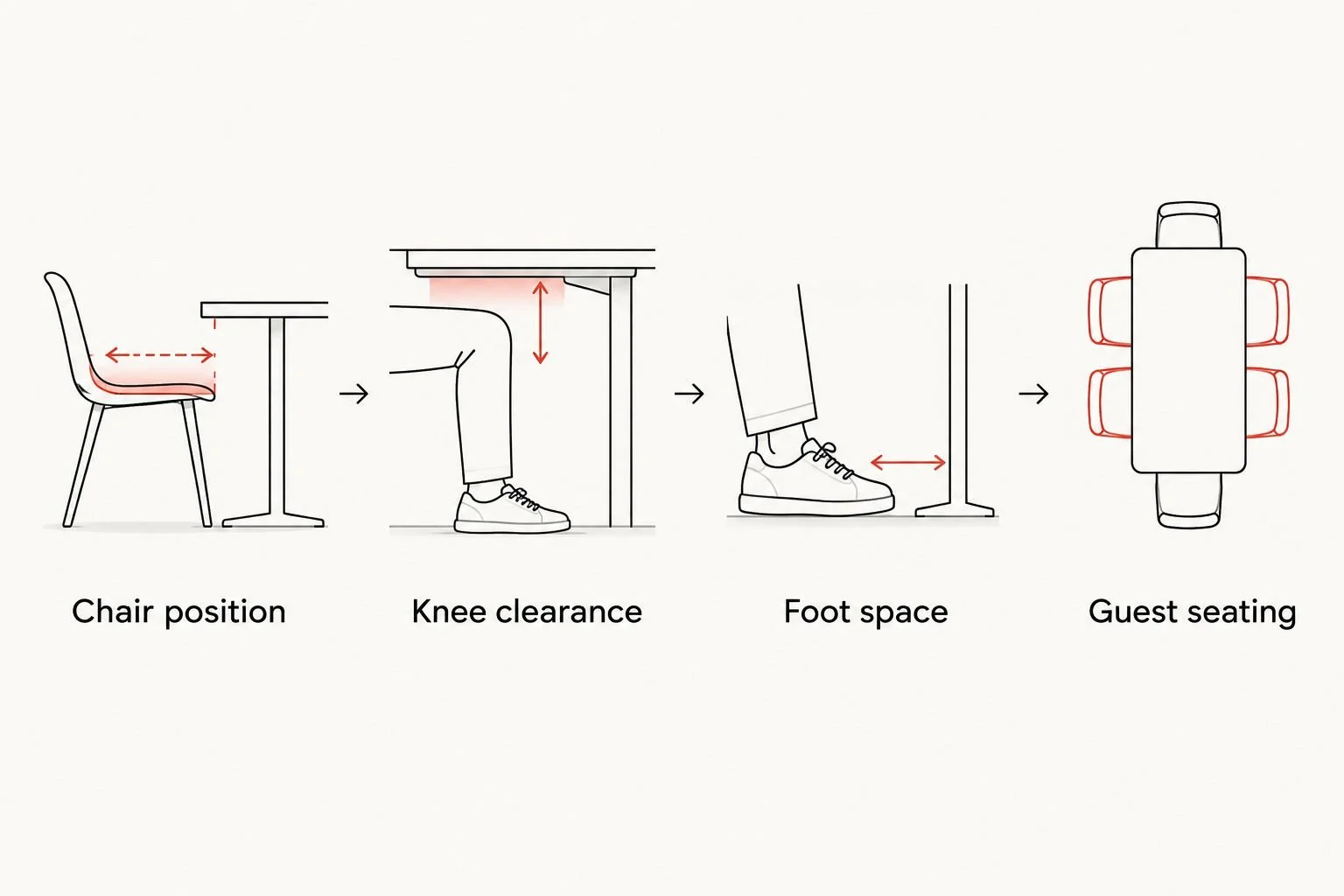
Check the space at your knees and feet, not just the outline of the tabletop.
For an illustrative seating plan, draw 4 chair positions around a round top, then a separate version with 6 chair positions. Those aren't capacity recommendations; they show how changing the arrangement changes where people meet the base.
For a rectangular example, add 2 end chairs to a side-seating layout. Now check whether the end sitters encounter a pedestal foot, an apron, or a leg that wasn't in anyone's way before.
A paper plan exposes conflicts, but it doesn't reproduce sitting. If you're assessing an existing table, pull a chair in, move your feet naturally, and try getting up again. Comfortable furniture needs to work during those movements, too.
Is a pedestal table less stable than a four-leg table?
A pedestal table isn't inherently less stable than a four-leg table. Stability depends on the support footprint, the relationship between top and base, the connections, and how the table contacts the floor.
Separate rocking from flexing. A table that rocks because its supports don't meet the floor evenly has a different problem from a tabletop that moves relative to its base.
When you can inspect a table, observe ordinary use: sitting down, resting your arms on the edge, and moving a chair. Don't use sitting or standing on the tabletop as a stability test.
Neither extra weight nor a thick tabletop proves the base is well designed. Ask how the top is supported and attached rather than using visual bulk as the answer.
Does a pedestal table seat more people?
A pedestal table can make chair placement easier because corner legs aren't dividing the edge into fixed openings. It doesn't automatically increase the usable perimeter of the tabletop.
People still need space for their shoulders, chairs, and place settings. A central base can also create a comfortable seat at tabletop level and an awkward one at floor level.
Treat extra seating as something to demonstrate in a layout, not a benefit guaranteed by the word pedestal. The occasional chair is still occupied by a person with knees.
A note from Robert: choose the base with the table
At Elmswick & Oak, I work directly with you on a custom dining table designed for your home. The useful starting point is how you want to use it and which chairs need to fit—not a rule that one base is always better.
If you already have chairs, their dimensions help make the discussion concrete. If you're still choosing chairs, consider them alongside the table rather than leaving that decision until afterward.
Custom work gives you room to address those relationships, but it still involves trade-offs. Moving a support to clear a chair changes the design problem; it doesn't remove the need for sound support.
Discuss your dining table
Work directly with Robert on a custom dining table designed for your home.
Explore custom furnitureFAQ
What's better for a round dining table, a pedestal or four legs?
A pedestal is the better starting point when you want flexible chair placement around a round dining table. Check its feet and column, because removing corner legs doesn't remove every obstacle beneath the top.
Do four-leg dining tables have more legroom?
Four-leg dining tables can leave more open space in the center, but the legs and apron can restrict individual seats. Check the opening where each chair actually sits.
Will pedestal feet get in the way of my chairs?
Pedestal feet interfere when they overlap the space needed by your chair legs or shoes. Check the footprint at floor level as well as the column beneath the tabletop.
Can I put an armchair at either type of dining table?
An armchair works with either base when its arms clear the underside and its legs clear the supports. Include any apron in the clearance check rather than measuring only to the tabletop.
Is a double pedestal better for a long dining table?
A double pedestal is an option for supporting a longer dining table without corner legs, not an automatic improvement. Check where both pedestals and any connecting stretcher land relative to the chairs.
Should I choose my dining chairs before the table base?
Choose your chairs and table base together whenever possible. If you already own the chairs, use their dimensions and positions to assess the proposed base.
Can Elmswick & Oak help me choose a custom dining table base?
Elmswick & Oak builds custom dining tables, and you work directly with Robert on a piece designed for your home. Discuss your chairs, preferred seating arrangement, and base concerns as part of that design conversation.
One last thing
Before choosing a base, look underneath a table you already find comfortable. Notice where your feet go when you're not thinking about them.
That's a more useful reference than an empty dining-room photograph. Choose the base that stays out of your way in real use, not just the one that looks least complicated from across the room.