How much does a custom dining table cost?
Okay, I know the title seems like I'm going to answer how much a custom dining table costs, but... it depends. Which is an annoying answer, but I want to help you understand why by providing some context.
There isn't one table we're talking about here. The size, wood, base, finish, and details of getting it into your home all belong in that conversation. So rather than give you a number that doesn't tell you much about your particular table, let's look at what goes into a quote and how to make sense of it.
TL;DR
- A custom dining table quote starts with the size, wood type, base, finish, and overall complexity of the design.
- Compare quotes for the same table, not just the totals at the bottom. Make sure you are comparing apples to apples.
- Your room and chairs matter just as much as the photograph you're using for inspiration.
Why this matters
You can find a table you love in a photograph and still end up with something that doesn't work in your dining room. Maybe the proportions feel wrong once the chairs are around it. Maybe the base looks great but sits right where your knees need to go.
That's the useful part of custom work: we can talk about those things instead of asking you to work around a table that's already been made. I'm Robert, and Elmswick & Oak is my custom woodworking shop in Ames, Iowa, serving homeowners across Central Iowa and the Midwest.
I want this to help whether you're thinking about working with me or just trying to understand what to ask another maker. You don't need to know furniture construction to have a useful conversation about a table.
How much does a custom dining table cost?
The honest answer is that your table needs its own quote. I know that still isn't a number. But a number without a size, material, design, or explanation of what's included leaves you guessing about what you'd actually be buying.
Think about the difference between a straightforward rectangular top on legs and a shaped top with a more involved base. They're both dining tables. That doesn't make them the same project.
When you're looking at a proposal, here's what you want to be clear on:
| Part of the quote | What to ask about |
|---|---|
| Tabletop | What are the dimensions, shape, wood, and edge details? |
| Base | How is it built, and where will the legs or supports sit? |
| Finish | What will it look like, and how do I take care of it? |
| Design | What needs to be decided and approved before the build? |
| Getting it home | Are delivery, assembly, and placement included? |
You don't need every task in the shop listed as a separate charge. You do need to understand what the finished project includes.
Compare what's included before you compare the totals. A quote that gets the table into your dining room isn't the same as one where you're collecting it from the shop. Neither arrangement is automatically wrong. You just don't want to discover the difference after you've made your decision.
Let's talk about the budget early
If you're comfortable sharing your budget, do that before getting too far into the design. Not because you should have to know what everything costs already, but because it gives the conversation somewhere useful to start.
You might care most about the wood. Or the overall shape. Or having enough room for the chairs you already own. Knowing both your budget and what matters to you helps us talk about which details to keep and which ones you're happy to change.
If a design doesn't fit the budget, the next question is what we can adjust. Size, materials, and construction are things to discuss—not reasons to pretend the same table can be made for a different amount without anything changing.
And a minimum project budget isn't a fixed dining-table price. It isn't a ceiling either. Your table still needs a quote for the actual design.
Why custom dining table quotes vary
Custom isn't one particular style of table. It means we're making decisions about your piece rather than choosing an existing one exactly as it is. Here are the main things behind those decisions.
Size and proportions
Length, width, and thickness affect the material needed and how the top needs to be supported. But bigger isn't automatically better.
Start with the room. You need to sit at the table, pull chairs out, and walk past it. A tabletop that fills the space isn't much use if it makes the rest of the room awkward.
The wood
Choosing wood isn't just picking a color from a photograph. Grain, knots, and variation between boards are part of what you'll see in the finished table.
If you like a more consistent look, say so. If you like visible variation, say that too. You don't need the technical vocabulary; a photograph and an explanation of what you like about it are a useful starting point.
The base
The base has a job beyond holding the top up. It also has to leave room for people.
Legs, pedestals, and the supports between them all affect where chairs can go and how comfortable those seats are. A base can fit underneath the top and still be in someone's way. That's why I wouldn't treat it as a detail to figure out at the end.
The finish
The finish changes the appearance of the wood and how you'll care for the surface. Ask what everyday use looks like: cleaning, spills, heat, and wear.
Don't assume that liking the look of a finish means you'll like everything about living with it. This is a good place to ask questions before making a decision.
The rest of the project
Design details, delivery arrangements, assembly, and access to the room all need to be clear. If there's a narrow doorway or an awkward turn on the way in, bring it up.
These decisions aren't separate little boxes. Changing the width can affect the base. Keeping a particular chair can affect the clearance underneath. It makes more sense to look at the whole table together.
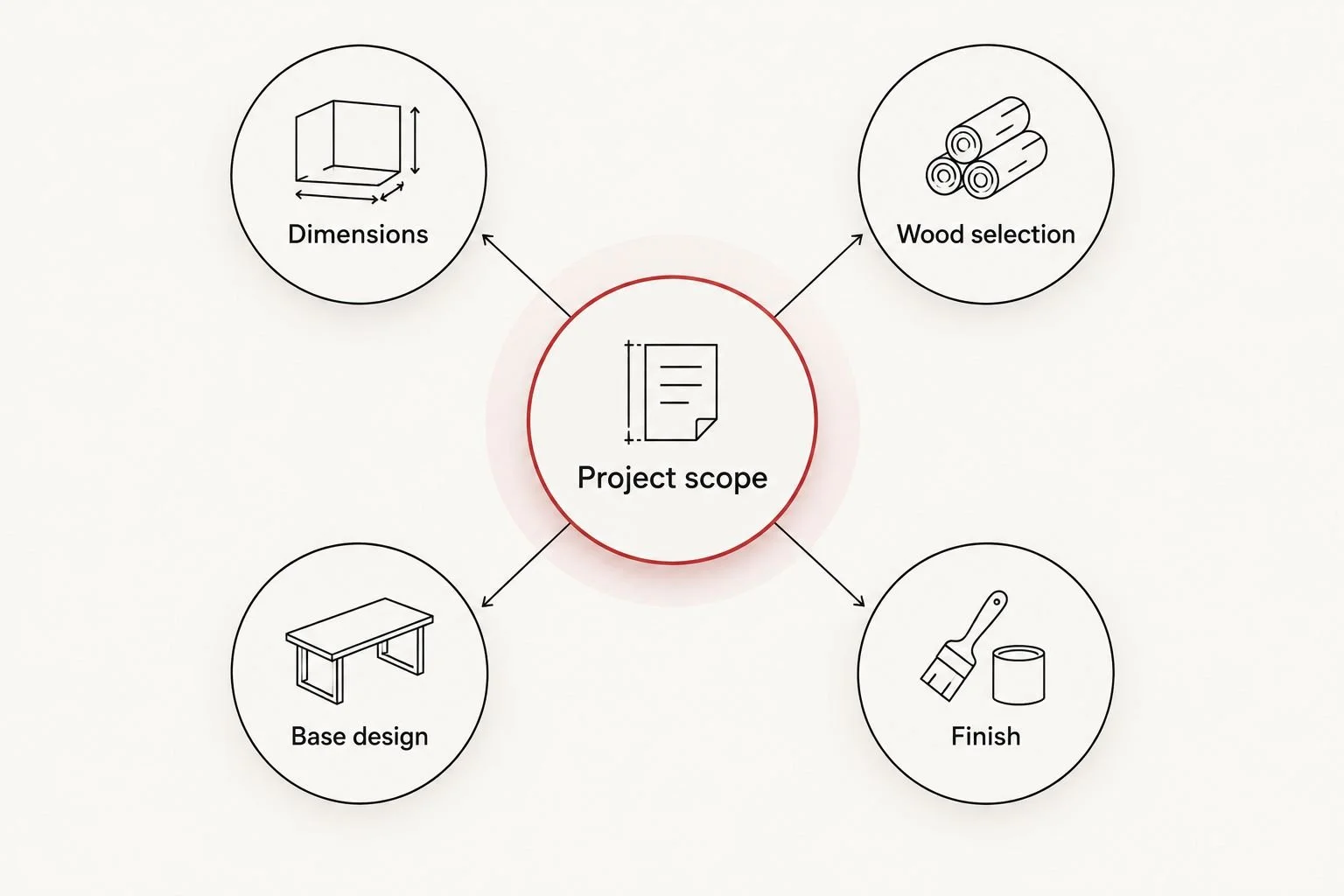
A useful quote connects the material choices with the whole table design.
Should you go custom or buy an existing table?
I'm a furniture maker, but I don't think custom is automatically the right answer for everyone. If you find an existing table you love and it works in your home, that's a perfectly good reason to buy it.
Custom makes sense when there's something you want to do differently—not just because the word sounds appealing.
| Where you're looking | Best for | What to check |
|---|---|---|
| Higher-end furniture store | Finding an existing design that works for you | Can you see samples, and what details can be changed? |
| Independent custom maker | Having a piece designed around your home | How do you work through decisions and approve the design? |
| Interior designer's furniture supplier | Coordinating a table with a wider room project | Who handles the specifications and approves changes? |
None of those routes guarantees the same services from every seller. Ask about the actual arrangement rather than assuming what comes with it.
The trade-off with custom work is that you'll be involved in decisions. That can be exactly what you want, or it can feel like more work than choosing an existing piece. Choose custom because it solves something for you: the fit, the proportions, the wood, or the way the table works with your chairs.
What to have ready when you ask for a quote
You don't need to arrive with a finished drawing. You also don't need to have every detail figured out. Here's what helps get the conversation started.
A look at the room
Take measurements and a few photographs that show the whole dining area. Include nearby furniture, doorways, and the paths people use through the space.
If you're unsure about the size, try marking the tabletop outline on the floor with removable tape. Put your chairs around it and move through the room. It won't answer every question, but it makes the size easier to picture than a measurement on its own.
The chairs you're keeping
If you already have chairs, include their measurements and photographs. Arms, wide backs, and the way a chair tucks underneath all matter.
Check where your knees and feet go too. Being able to slide a chair under the edge isn't the same as being comfortable when you sit down.
How you'll actually use it
Is this where you eat every day? Does it also need to handle homework? Are you planning around your household or the occasional gathering?
Explain the everyday version first, then the guests-at-the-holidays version. Both matter, but they aren't necessarily the same seating arrangement.
And please don't feel like you need to turn your preferences into construction instructions. Saying you want a table that looks lighter is helpful. You don't have to decide exactly how thin the top should be before we've talked about the design.
Photographs with a little explanation
Reference photos help more when you tell me what you're looking at. Is it the color? The shape of the legs? The edge? Or just the way the table feels in that room?
It's equally useful to know what you don't like. You might love the top in a photograph and dislike the base. That's worth saying rather than assuming the whole picture is the goal.
A clear written description before you approve
Before the build, make sure the dimensions, wood, design, finish, and responsibilities are written down. Ask how changes are handled and which decisions need to be settled.
If a conversation changes the design, the written information should reflect that. It's much easier to check a detail there than to rely on everyone remembering the conversation the same way.
Let's talk about your table
Work directly with me, Robert, on a custom piece designed for your home.
Explore custom furnitureIs a custom dining table worth it?
It's worth considering when an existing table leaves something important unresolved. Maybe the length isn't right, the base interferes with your chairs, or you want a different combination of wood and proportions.
If an existing table already does what you need, you don't have to commission one just because you can. The point is getting a table that works for you.
Does solid wood automatically make it a better table?
No. Solid wood is a material choice, not an answer to every question about construction, support, or finish.
It also moves as moisture conditions change. Ask how the design allows for that movement and what care the surface needs. There's more to a good table than the material name.
How do you compare quotes from different makers?
Give each maker the same starting information: room measurements, intended size, wood preferences, chairs, and delivery needs. Then look for differences in the designs and what's included.
If the proposals describe different tables, decide whether those differences matter to you before comparing the totals as though they're for identical work.
FAQ
How much does a custom dining table cost?
It depends on the table's size, wood, base, finish, and what the project includes. A quote for your particular design is more useful than a number that doesn't explain what you're getting.
What should I send when asking for a custom dining table quote?
Start with room measurements, chair details, reference photographs, and your budget. You don't need every decision made; explain what matters to you and what you're still figuring out.
Is a custom dining table better than one from a furniture store?
Custom is a better fit when you need changes an existing design doesn't offer. If a store's table already works for your room and you love it, custom isn't automatically the better choice.
Can I keep my existing dining chairs?
Your existing chairs can be part of the design brief. Share their dimensions and check arm clearance, leg placement, and space for knees before approving the table.
What should I ask about the finish?
Ask how to clean it and what to expect from spills, heat, and everyday wear. You want to understand living with the finish, not just how it looks in a photograph.
Does the quote include delivery?
Only if the quote says it does. Ask about access, assembly, and placement too, so you know who's responsible for getting the table into the room.
Who is Elmswick & Oak's custom dining table work best for?
Elmswick & Oak suits homeowners who want to work directly with Robert on a custom dining table designed for their home. The shop is based in Ames, Iowa, serving Central Iowa and the Midwest.
One last thing
Before you fall in love with the tabletop, look underneath it. Where are the legs? Is there a support where someone's feet need to go? Will your chairs work with it?
I know those aren't always the details that catch your eye in a photograph. But they're the details you'll notice when you sit down. A table should work just as well when you're using it as it does when you're looking at it.