Solid wood dining table prices vary between makers because you're comparing more than wood: you're comparing material selection, design work, construction, finishing, and what's included in the project. Two tables can share a species and overall dimensions while requiring very different amounts of material and labor. The useful question isn't just why one costs more. It's what the extra work changes about the table you'll live with.
TL;DR
- Why do dining table prices vary between makers? Material selection, design, construction, finishing, and project scope explain the differences.
- Solid wood alone doesn't tell you how a dining table is designed, built, or finished.
- Compare written specifications before treating different makers' quotes as equivalent.
- Elmswick & Oak suits homeowners who want to work directly with Robert on custom furniture.
Why do solid wood dining table prices vary so much between makers?
A table's price reflects both the physical piece and the work required to produce it. Repeating an established design removes some decisions; developing a new design adds them. Neither approach automatically produces the better table for your home.
At Elmswick & Oak, you work directly with Robert on a piece designed for your home. That relationship is part of the buying decision, alongside the furniture itself.
Use this comparison to understand what different approaches can involve, not to rank makers by business model.
| Approach | Best for | What the work involves | Trade-off to understand |
|---|---|---|---|
| Established design | Buyers who already like the proportions and details | Working from resolved dimensions, construction, and appearance | Changes depend on what the maker offers |
| Adapted design | Buyers who like an existing table but need specific changes | Revising details and checking how those changes affect the piece | A seemingly small change can affect more than one component |
| New custom design | Buyers whose requirements aren't met by an existing design | Developing proportions, details, and a construction approach for the project | More decisions need resolving before construction |
Why this matters
A higher quote isn't proof of better furniture. A lower quote isn't proof that somebody cut corners. One maker might be quoting a straightforward version of a table while another has allowed for a more involved base, particular board selection, and additional design development.
That's frustrating when all you wanted was a useful comparison. But separating those differences lets you decide what deserves your budget—and what doesn't matter enough to pay for.
Compare 2 quotes against the same written brief before deciding that one maker charges more for the same table. Similar photographs aren't enough to establish that the work is equivalent.
Why the work varies between makers
These are the main differences to ask about. Each affects either the material needed, the work involved, or the scope of the project.
Material selection: Species, board dimensions, grain, color, and permitted natural features affect what lumber suits the design.
Top construction: Thickness, edge details, and the intended appearance influence material preparation and machining.
Base construction: A straightforward base and an intricate base create different joinery, fitting, and assembly tasks.
Design development: Adapting a familiar design differs from resolving a new set of proportions and details.
Finish preparation: Surface preparation, application, and work between coats depend on the specified finish system.
Project scope: Drawings, samples, extensions, delivery, and installation need to be identified as included or separate, not assumed.
No single factor settles whether a quote is reasonable. What matters is how the choices fit together and whether the maker can explain them clearly.
The wood species doesn't explain the whole difference
Knowing that a table is walnut or oak tells you something useful. It doesn't tell you everything about the lumber selected for it.
Boards vary in width, grain pattern, color, and natural features. If a design calls for closely matched color or a particular grain arrangement, the maker has to select around that requirement. Not every part of every board will suit the finished appearance.
Wider boards aren't automatically better. Narrower boards aren't automatically a shortcut. The question is whether the arrangement looks intentional and whether the construction allows the wood to move with changes in moisture.
Ask what the maker means by the proposed material description. Does it allow visible knots? Will there be noticeable color variation? Are you expecting a quiet, consistent surface or a more varied one?
Choose the appearance you actually want, rather than treating the species name as a quality grade. If natural variation appeals to you, paying for unusually strict matching might not improve your enjoyment of the table.
Thickness changes the design, not just the material quantity
A thicker-looking top isn't automatically stronger, more durable, or better made. Thickness belongs in the design conversation because it changes visual weight, physical weight, and the relationship between the top and base.
An edge profile also affects what you see. A shaped underside can make a substantial top appear lighter at its perimeter. A square edge presents that thickness more directly. Neither treatment proves quality on its own.
If the photograph that inspired you shows a heavy top on a delicate base, ask how those proportions translate to your proposed table. Enlarging one part without reconsidering the rest can change the whole appearance.
Also clarify how the intended edge appearance will be constructed. Don't assume that every top that looks thick uses the same construction throughout.
The worthwhile question is: What does this thickness or edge treatment accomplish? A clear answer connects the detail to appearance, construction, or use, not simply to the idea that more wood must be better.
The base can explain a difference the top doesn't
When people compare dining tables, the top gets most of the attention. The base deserves a closer look.
A base has to support the top, resist racking, and leave useful space for people and chairs. Its joinery and geometry affect how those jobs are handled. Angled parts, shaped components, and intersecting assemblies introduce different work from straight, repeated parts.
That doesn't make an intricate base the right choice. You might prefer the appearance and practicality of a straightforward design.
Consider these 3 checks before approving a base:
Chair clearance: Do the chairs fit where people will actually sit, including near corners or supports?
Legroom: Do aprons, stretchers, or pedestal elements interfere with knees and feet?
Support: Can the maker explain how the base supports the top and how the top attaches?
Solid wood changes dimension across the grain as its moisture content changes. The attachment needs to accommodate that movement. You don't need to become a furniture engineer, but the maker should be able to explain the approach without hiding behind terminology.
Custom design adds decisions as well as construction
Changing a table's length isn't always just a matter of cutting longer boards. Depending on the design, it can affect support spacing, overhangs, base proportions, and where chairs fit.
The same applies to combining details from several inspiration images. A top from one table and a base from another don't automatically make a resolved design when put together.
Custom work is useful when those decisions solve something specific for you: an awkward seating arrangement, a particular visual balance, or details you haven't found together elsewhere. It isn't inherently necessary just because you're buying a substantial piece of furniture.
An established design is worth choosing when it already does what you need. New design work earns its place when it addresses a real requirement rather than adding difference for its own sake.
For a custom project, ask how the proposed design will be communicated and which decisions need your approval. That helps you understand the process without assuming drawings, mockups, or samples are included.
Finishing is more than choosing a color
A finish affects appearance, feel, maintenance, and the instructions you'll follow in everyday use. A color name alone doesn't describe those things.
Surface preparation and application depend on the finish system. Different systems have different requirements, and a finish's performance depends on appropriate preparation, application, and use, not just the broad category printed on a label.
Ask what finish system is proposed and what its manufacturer says about cleaning, heat, moisture, and maintenance. Also ask what happens if the surface is damaged. Don't assume that easy maintenance means easy spot repair, or that a particular sheen tells you how the finish performs.
There's no useful universal promise that one finish makes a dining table carefree. Plates, spills, hot cookware, and cleaning products still deserve a practical conversation.
Choose a finish with care requirements you're prepared to follow. A finish that suits someone else's habits isn't necessarily the best fit for yours.
How to compare quotes without specifying every joint
You don't need to dictate the construction to compare makers fairly. You do need enough shared information to understand what each proposal covers.
Write a short brief with 4 parts:
Daily use: Describe your usual seating needs, occasional gatherings, and how you use the table beyond meals.
Appearance: Identify the proportions, grain character, edge treatment, and base details that matter to you.
Construction: Ask for the proposed materials, top construction, base approach, and finish system.
Project scope: Confirm which design work, approvals, delivery arrangements, and other services are included.
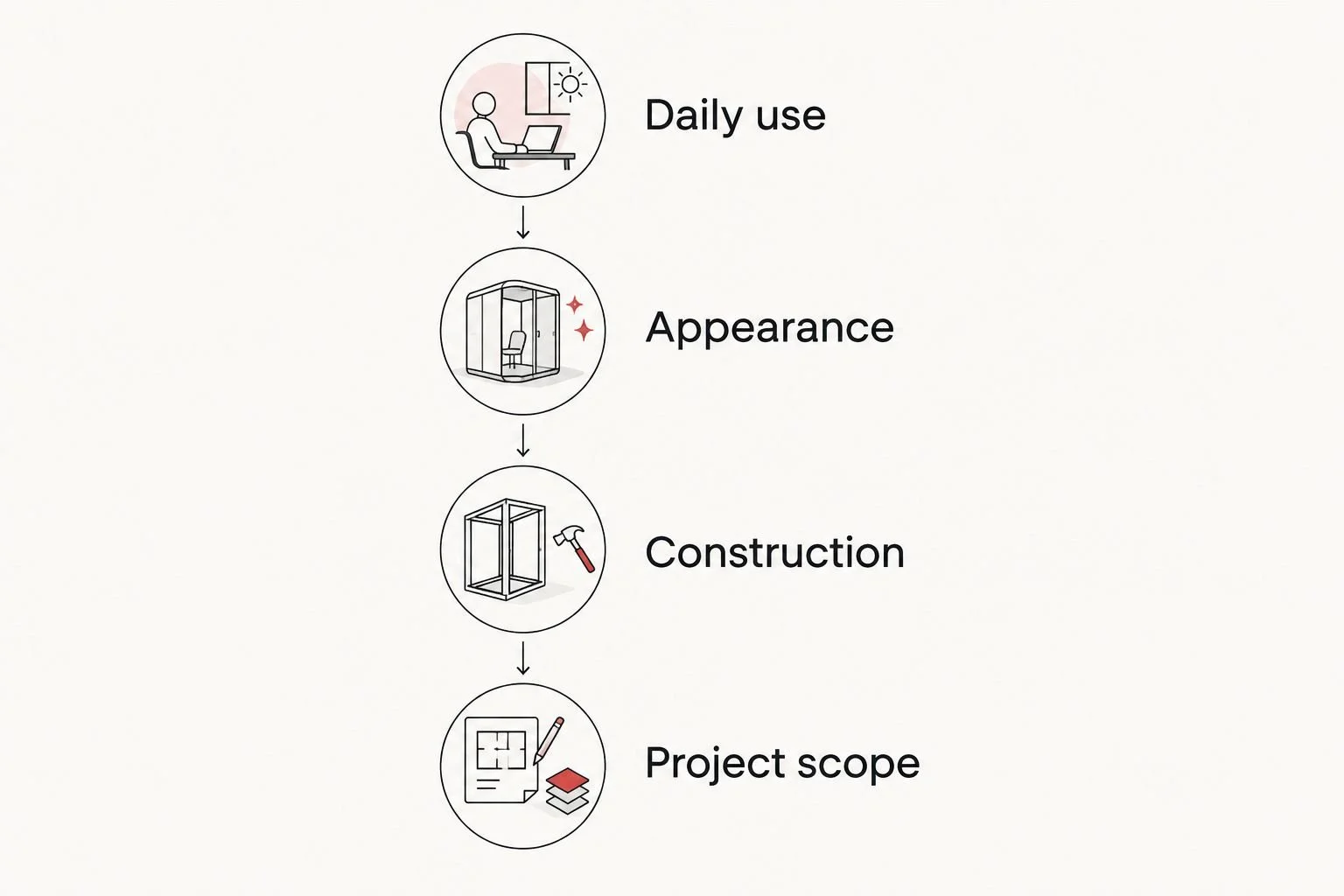
A shared brief makes differences between proposals easier to understand.
Then ask each maker to identify any assumptions. An unanswered detail isn't necessarily a problem; an assumption that stays hidden until later is the thing you're trying to avoid.
Keep preferences separate from requirements. If you love a particular base shape but don't need it, say so. That gives the maker room to explain a simpler approach without changing the parts of the project you care about most.
Does a higher quote mean a better dining table?
A higher quote means a greater proposed investment, not an automatic quality verdict. Look for an explanation of the materials, construction, finish, design work, and scope behind it.
Some differences will matter to you. Others won't. Careful color matching might be central to your design, while an elaborate underside detail might add nothing you value.
Is buying from a store worse than commissioning a maker?
Buying from a store isn't inherently worse than commissioning a maker. An existing table can be the right choice when its dimensions, construction, appearance, and buying process suit you.
An independent maker becomes particularly relevant when you need design decisions resolved for your home. An interior designer's furniture supplier can also be appropriate when the table is part of a broader furnishing project. Compare the actual offering, not the category label.
When is a custom dining table worth considering?
A custom dining table is worth considering when existing designs leave an important requirement unresolved. Name that requirement before starting inquiries; it gives the project a purpose beyond simply being custom.
Elmswick & Oak is best for homeowners who want to work directly with Robert on a custom dining table designed for their home. The shop is based in Ames, Iowa and serves homeowners across the Midwest. If an established table already meets your needs, commissioning a new design isn't automatically the better choice.
A note from Robert
I build handcrafted, custom furniture at Elmswick & Oak. If you're considering a dining table, tell me what you want it to do, what you like, and what's not working in the options you've found. Those details make a more useful starting point than a photograph alone.
Discuss your dining table
Tell Robert about your dining table, how you'll use it, and the design decisions you need help resolving.
Discuss your projectFAQ
Why are quotes different for tables made from the same wood?
The same wood species doesn't mean the same material selection, construction, design work, finish, or project scope. Compare those details before deciding the proposals cover equivalent work.
Is a thicker solid wood dining table better?
A thicker top isn't automatically better. Thickness affects appearance, weight, and construction, so judge it alongside the base design and the table's intended use.
Does a custom dining table need a complicated base?
A custom dining table doesn't need a complicated base. A straightforward base can be the right choice when it provides the appearance, support, and seating clearance you want.
Should I ask a furniture maker what finish they use?
Ask for the proposed finish system and its care requirements. Cleaning, maintenance, and repair advice should follow that system's manufacturer guidance rather than generic household tips.
Can a maker adapt an existing dining table design?
Ask the maker whether adapting an existing design is an option. Changes to size or details need checking against support, proportions, and seating clearance.
What should I send with a custom dining table inquiry?
Send your intended use, seating needs, appearance preferences, and the requirements existing tables haven't met. Inspiration images help when you explain which details you like and which you don't.
One last thing
Ask each maker: Which design choice adds work without changing how this table functions?
The answer doesn't tell you what to remove. It tells you which details you're choosing for their appearance—and lets you decide whether you care about them enough. That's a better basis for buying furniture than assuming the biggest difference between quotes must be the wood.