A solid wood tabletop should be thick enough for its unsupported span and intended use, with the base doing its share of the work. There isn't a universal finished thickness that makes every table sound: a relatively thin top with well-placed support can work better than a thicker top on an unsuitable base. Choose the finished thickness, support layout, and edge profile together, not thickness alone.
TL;DR
Solid wood table top thickness depends on unsupported span, base support, and wood condition, not appearance alone.
Rough lumber thickness isn't finished tabletop thickness; surfacing removes material.
A built-up edge adds visual weight without making the entire tabletop equally thick.
How thick should a solid wood tabletop be?
Choose thickness for the part of the top that actually has to span between supports. Overall table length doesn't tell you that distance. Two equally long tables can ask very different things of their tops.
| Construction situation | What it means for thickness | Best for | Trade-off to check |
|---|---|---|---|
| Supported top with an apron beneath it | The apron helps support the top: thickness isn't doing the job alone | A lighter-looking top with a supporting frame | The apron also occupies space above your knees |
| Open span between widely spaced supports | More of the top must resist bending without nearby support | Designs where open space beneath the top matters | Thickness and support placement need to be considered together |
| Substantial overhang beyond the base | The projecting portion needs its own assessment | Seating layouts that need an inset base | A thick-looking edge doesn't establish whether the overhang is adequately supported |
At Elmswick & Oak, I build custom furniture for homeowners across the Midwest from my shop in Ames, Iowa. For a tabletop, the useful conversation is about the whole piece: how the top looks, what supports it, and how you'll use it.
Why this matters
Thickness affects more than whether a tabletop bends. It changes the apparent weight of the furniture, the space beneath it, and how the edge feels against your forearm.
A top can look substantial and still have an awkward base. It can also look light and work well because the support is doing its job. Thickness is a design decision, not a quality score.
Start with finished thickness, not the lumber listing
Hardwood lumber is commonly described in quarter-inch thickness designations. Those describe nominal rough stock, not a promise about the finished tabletop you receive.
| Rough-stock designation | Nominal rough thickness | What it tells you | What it doesn't tell you |
|---|---|---|---|
| 4/4 | 1 inch | The stock's nominal thickness category before surfacing | The finished tabletop thickness |
| 5/4 | 1¼ inches | A thicker starting stock category than 4/4 | How much material flattening will remove |
| 8/4 | 2 inches | A substantially thicker starting stock category | Whether that thickness is necessary for your design |
Flattening and smoothing remove wood. A board that's twisted or cupped requires material to come off before both faces are flat and parallel, so rough stock thickness and finished thickness aren't interchangeable.
If you're comparing proposals, ask for finished tabletop thickness. Otherwise, you might compare one maker's rough-lumber description with another maker's finished dimension and think you're looking at equivalent specifications.
Nor does starting with 8/4 stock automatically make a table better than one made from 4/4 stock. It gives the maker more material to work with. Whether that material belongs in your table is a separate question.
Why the right tabletop thickness varies
These are the factors worth discussing before settling on a dimension:
Unsupported span: The distance between effective supports matters more than overall length alone. A long stretch without support places different demands on the top.
Base support: Aprons, rails, and the locations where the base supports the top all affect how the assembly behaves. A leg count isn't a support plan.
Wood condition: Knots, cracks, grain direction, and other characteristics affect how a particular board performs. Species alone doesn't settle the question.
Edge profile: A bevel or rounded edge changes the appearance and feel of a top without necessarily changing its central thickness.
Legroom: Top thickness, apron depth, seat height, and overall table height work together. Adding material underneath can take space away from the person sitting there.
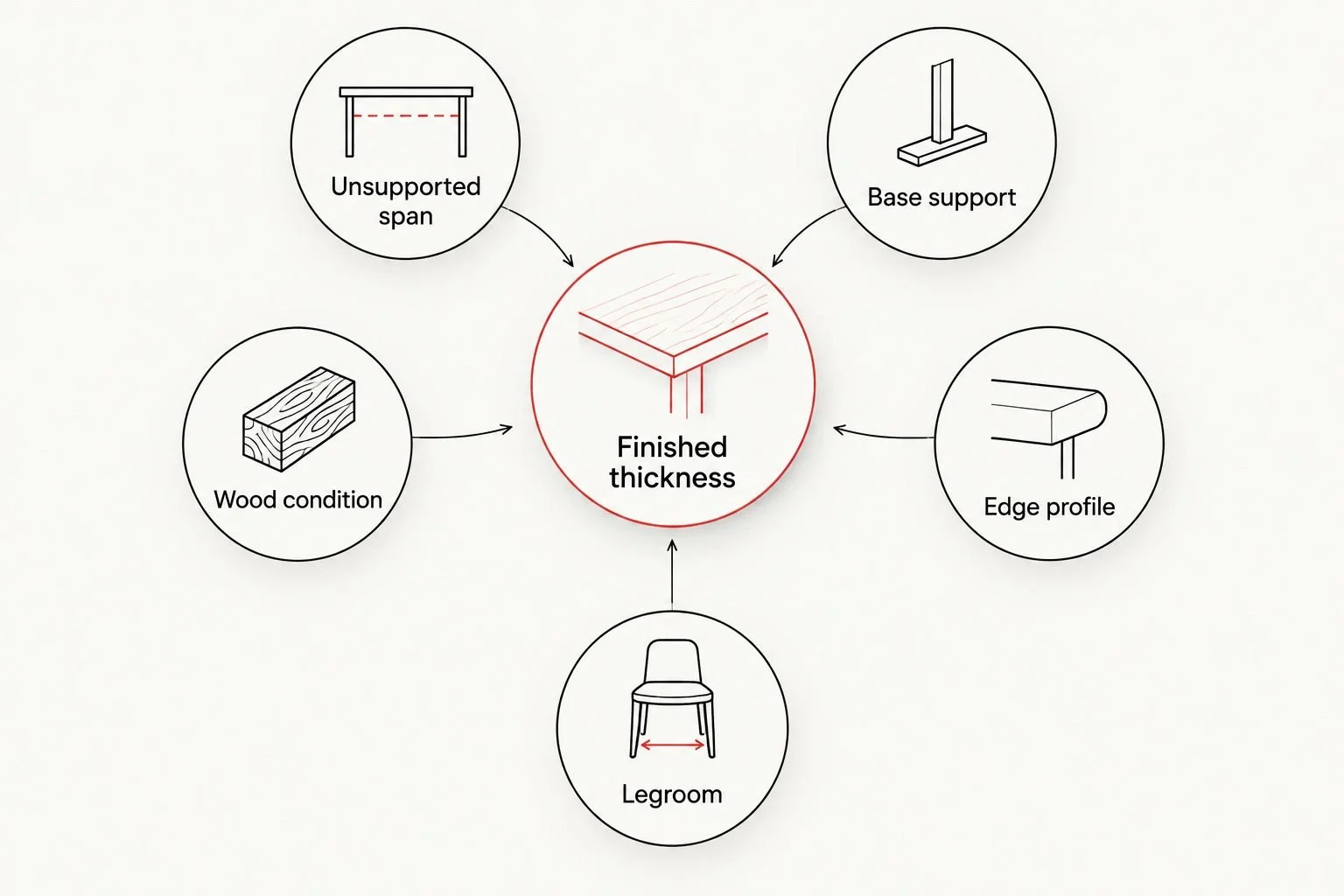
Choose finished thickness as part of the whole table design, not as an isolated specification.
Those factors interact. Adding an apron can change the top's support, but it also changes the space underneath. Making a top thicker can change its proportions, but it doesn't fix a poorly arranged base.
That's why a thickness recommendation without a drawing or support description is incomplete. You don't need an engineering lecture to buy a dining table. You do need to know what sits beneath the surface.
A thick edge isn't always a thick tabletop
A photograph shows the perimeter well. It doesn't necessarily show the construction behind it.
A tabletop can have the same thickness across its main surface, or it can use additional material around the perimeter to create a deeper-looking edge. Neither approach deserves an automatic thumbs-up or thumbs-down; they serve different design goals.
| Edge construction | Best for | Advantage | Limitation |
|---|---|---|---|
| Full-thickness top | A design that calls for substantial material throughout | The visible edge reflects the main top's thickness | More material also means more weight |
| Built-up edge | A deep-looking perimeter without an equally thick central panel | Separates visual depth from the main panel's thickness | Edge depth alone doesn't describe the panel's structure |
| Beveled underside | A substantial top that should look lighter at the perimeter | Reduces the visible edge while retaining material farther inward | The slim-looking edge can hide the top's actual depth underneath |
Ask what the thickness describes: the main panel, the perimeter, or both. That's a straightforward question, not an accusation that a construction method is wrong.
A built-up edge isn't inherently a shortcut. It becomes a problem when you're buying on the assumption that the whole top has the thickness you see at the edge. Clear descriptions prevent that mismatch.
What changes between dining, coffee, and end tables?
The furniture category gives you a starting point, not a thickness specification. Within each category, support layouts and proportions vary considerably.
Dining tables: check support and seated comfort
A dining top needs to work with the base and the people sitting around it. Look at the overhang, where the supports sit, and whether an apron interferes with the chair arms or your thighs.
A substantial top can suit the room beautifully. But if the top, apron, and chair leave you feeling wedged in, the impressive edge isn't helping. Check the seated relationship before choosing thickness for appearance alone.
Coffee tables: consider the edge as well as the surface
A coffee table sits lower, where you see more of its top from above. The edge profile still affects how heavy or light the piece looks, particularly beside upholstered furniture.
Tell the maker how you actually use it. A surface for books and drinks is a different brief from furniture someone intends to sit on; don't assume a tabletop is designed as seating because it looks sturdy.
End tables: keep thickness in proportion
On a compact end table, a deep edge can become a dominant feature. That can be exactly the look you want, but it should be a deliberate choice rather than an assumed sign of better construction.
Look at the top together with the legs and any lower shelf. The question is whether those parts look and work like one piece of furniture, not whether the top wins a thickness contest.
Does a thicker solid wood top resist warping better?
A thicker top isn't a substitute for appropriate drying, construction, and attachment. Solid wood changes dimension as its moisture content changes, and the movement is greater across the grain than along it.
The connection between the top and base needs to accommodate that movement. Simply fastening a solid wood top rigidly wherever convenient doesn't become sound practice because the top is thick.
Also, bending under a load and seasonal wood movement aren't the same problem. More thickness can increase resistance to bending, but that doesn't establish whether the wood was prepared appropriately or attached correctly.
Ask how the top connects to the base and allows for movement. A clear explanation of that detail tells you something thickness alone cannot.
Does a thicker tabletop mean better quality?
A thicker tabletop means more material, not automatic quality. Wood selection, sound joints, suitable support, surface preparation, and the finish all matter independently of thickness.
Thickness doesn't tell you whether a finish will tolerate a hot dish or a particular cleaning product, either. Those questions belong to the actual finish system and its care instructions.
When you're comparing higher-end furniture stores, independent makers, or a designer's furniture suppliers, ask the same questions of each. What's the finished thickness? How is the top supported? What does the finish require? Judge the answers rather than the sales language.
A thin-looking edge isn't proof of weak construction, and a heavy-looking edge isn't proof of careful workmanship. Look for a design whose details make sense together.
What should you ask before approving a custom tabletop?
You don't have to arrive with the thickness already decided. Bring the use and appearance you want, then ask the maker to connect those preferences to a construction plan.
Confirm the finished thickness. Make sure the dimension describes the completed top rather than the rough lumber.
Identify the support layout. Ask where the top is supported and which portions extend beyond or between those supports.
Clarify the edge construction. Find out whether the visible edge represents the whole panel or includes a built-up detail.
Check the seated relationship. For dining furniture, consider your chairs alongside the top, apron, and table height.
Discuss movement and care. Ask how the top attaches to the base and request care guidance for the finish being used.
For a custom project with Elmswick & Oak, you work directly with me on a piece designed for your home. If you're ready to discuss a table, contact the shop with the type of piece, how you'll use it, and the look you're after.
You don't need a finished specification in that first message. A clear explanation of what matters to you is more useful than choosing a thickness because it sounded reassuring online.
FAQ
What's the best solid wood table top thickness?
The best solid wood table top thickness is the finished thickness that suits the unsupported span, base, and intended use. There isn't a universal dimension that establishes whether every tabletop is adequately supported.
Is 4/4 lumber a finished 1-inch tabletop?
4/4 denotes nominal 1-inch rough stock, not a guaranteed finished 1-inch tabletop. Flattening and smoothing remove material, so ask for the finished thickness separately.
Is 8/4 lumber necessary for a dining table?
8/4 lumber isn't a universal requirement for a dining table. It denotes nominal 2-inch rough stock; whether that starting thickness makes sense depends on the finished design and construction.
Can a thinner tabletop still be well made?
A thinner tabletop can be well made when its material, span, and support are appropriate. Thickness alone doesn't establish the quality of the joints, finish, or overall construction.
Is a built-up tabletop edge a bad thing?
A built-up tabletop edge isn't inherently bad; it creates a deeper-looking perimeter without making the entire panel equally thick. Ask the maker to distinguish edge thickness from main-panel thickness.
Will a thicker wood tabletop stop seasonal movement?
A thicker wood tabletop doesn't stop seasonal wood movement. The top still needs suitable construction and an attachment method that accommodates movement across the grain.
Can Robert help choose the thickness for a custom table?
You can discuss tabletop thickness directly with Robert at Elmswick & Oak as part of designing custom furniture for your home. Consider the base, edge profile, intended use, and overall proportions together.
One last thing
Ask to see the underside. A top-down photograph shows the wood and shape; an underside view or drawing helps explain where the support comes from and how the top connects to it.
That's often a more useful next step than asking for a thicker top. You're buying a table, not just a slab with a convincing edge.